

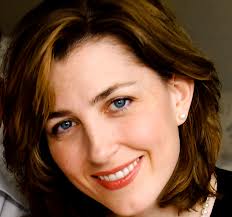
 In the spring of 2001, five years after Colleen Carroll Campbell had moved from Memphis to St. Louis to write for the St. Louis Post Dispatch, she fell in love with John Campbell, a young physician in training who would become her husband. Their love story is endearing and genuinely sweet. During this same time, in 2001, she took a year-long leave from the newspaper to write her book titled: The New Faithful: Why Young Adults Are Embracing Christian Orthodoxy (Chicago: Loyola Press, 2002). She describes this project as a “labor of love . . . a young writer’s dream” (55). She received a grant to travel around the country interviewing hundreds of her peers, mostly Catholics and evangelicals. Her desire was to track and reveal a growing trend among younger adults who were embracing more orthodox expressions of the Christian faith. Her interest grew out of her own experience of faith and astute professional observations. The book is not based on a poll, or the gathering of scientific data. It is anecdotal and profoundly fun to read. She met many fascinating young adults, across a wide spectrum and from most regions of the country, but the most interesting person she met, at least to her, was the man she met who she would later marry. She describes John as “warm, curious, lighthearted, and utterly lacking in artifice” (57). She struggled with how to pursue her writing career and become deeply involved with John. Finally she said to him, “I serve God through my work, too, you know. I don’t intend to give it up just to get married. If you are looking for a conventional doctor’s wife, you’re going to have to find someone else.” John responded by saying, “I think your writing career is terrific. If I wanted a wife who had nothing to do but focus on me, I would never have been so attracted to you. I want you. I love you” (59, the italics are her’s).
As Colleen’s first book became quite a point of discussion in various circles her professional opportunities increased exponentially. Soon she was offered a speech writing position in the George W. Bush administration. She left St. Louis to spend almost a year in Washington, DC. She says of this moment, when she was riding a wave of journalistic success which took her away from John and her home in St. Louis, “For the first time in my life, I felt sorry for my success” (65). But with John’s complete support she went to serve in the White House. (I will not give away much about her time there or her response to the people and events but it is well worth reading!)
Colleen now faced a new challenge–how to reconcile her desire for a prestigious career with her growing desire to marry John. The saint who helped her at this point was Maria Faustina Kowalska. 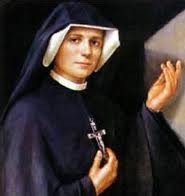 Reading the story of Faustina makes you wonder, at least at first glance, how this woman could become a powerful role model for an ambitious woman like Colleen. There are no pre-conversion struggles with Faustina nor an indulgent childhood. “She was pious practically from birth” (66). Faustina had a mystical encounter with Jesus and said, in response, “Jesus, I trust in you.” But she was wary of her encounter and confided her incredible vision to only two people–her superior and her spiritual director. Interestingly, they ordered her to work with an artist to paint a portrayal of what she saw. She also began to keep a journal and through this record tracked a number of mystical experiences over a seven year period before her death from TB in 1938. (She was only 33 when she died.) Her writing became the basis for a great deal of popular devotion in the Catholic Church today. Her message is quite simple–the modern world needs God’s mercy as never before, given our profound inhumanity and unbelief. You can only access God’s ocean of divine love by asking for it. Jesus wants us to ask for his love and to seek for him. Faustina reports that Jesus told her, “The graces of my mercy are drawn by means of one vessel only, and that is trust. The more a soul trusts, the more it will receive.” You cannot refute that even if you wanted to try.
One of the first great Catholics to discover Faustina, and thus help make her writing so widely popular, was Karol Wojtyla, who was of course the future Pope John Paul II. He discovered her writings living in Nazi-occupied Poland. John Paul’s favorite verse, used throughout his pontificate, was: “Be not afraid.” This reflected his desire to trust God’s providence, teaching that he had learned from the humble Faustina.
This underscores, for me at least, another aspect about the lives of the saints that Protestants find hard to understand. Saints are not “saviors.” They are not intermediaries. They are believers who lived well and whose lives show how to trust God and live faithfully. Faustina, for example, was a simple, humble woman with no real education. Yet her devotions have moved men and women to great depth and insights. (This is a lovely thing because it wonderfully illustrates the truth of 1 Corinthians 1:18-31). The depth of God’s love and grace is often revealed in the “weak things of this world” and the lives of the saints underscore this truth.
But what about the idea of saints and the teaching of the Catholic Church about them? First, I believe all true Christians are called “saints” in the New Testament (cf. 1 Cor. 1:2, 2 Cor. 1:1, Eph. 1:2, Phil. 1:1, Col. 1:2,etc.). The term itself is used as a virtual synonym for a Christian. Second, the word saint does not refer to some kind of specially holy person, but to all of those who seek holiness in Jesus Christ. But the unique use of saints as a title represents, in Catholicism, a “model” for all others. Think of them as “heroes” of the faith. The Catholic Church has an extensive process for “making saints” that I believe has no biblical or theological warrant but the end result is not, in itself, a negative. Further, the mystical experiences of many of these saints are not “meant to improve or complete Christ’s definitive revelation, but to help live more fully by it in a certain period of history” (Catechism of the Catholic Church, cited on page 69). Colleen writes of her “self-reliance and studied detachment” which had served her quite well in her “peripatetic childhood and compartmentalized college years” but when she embarked upon her White House year she needed someone to help her get through some major dilemmas. For her the answer was Faustina. She writes, “Her spirituality of trust would become an inspiration and a rebuke to me in the challenging days ahead” (71).



“–the word saint does not refer to some kind of specially holy person, but to all of those who seek holiness in Jesus Christ. But the unique use of saints as a title represents, in Catholicism, a “model” for all others. Think of them as “heroes” of the faith. The Catholic Church has an extensive process for “making saints” that I believe has no biblical or theological warrant but the end result is not, in itself, a negative.” Thank you John for clarifying the meaning ‘saints’
James H Kim liked this on Facebook.
LifeCoach Gwen Griffith liked this on Facebook.
I love her love story. She found a man who would love her and embrace her career and ambition as well.
Nick Morgan liked this on Facebook.