Is the "Dark Night" of Christianity in the West Inevitable?

By |2021-07-02T06:15:39-05:00May 23rd, 2013|Categories: ACT 3, Church History, Culture, Current Affairs, Missional Church, Missional-Ecumenism, Renewal, The Church, The Future|

imagesAre we living in a “dark night” for Christianity in the West? The church, and culture shaping Christian influences, have both been losing ground since the late 1950s. The only people who seem unaware of this are Christians of my own generation, people who continue to do the same things they were doing twenty years ago. They seem to do this as if this is what we really need in a time of rapid declension and loss–opposition to serious change.  I think a lot about these issues because of my missional-ecumenism vision.

I’m a historian and missiologist by training. I love to remind people about our Christian past, not as a wistful reminder of better days but as a reality check about where we are now and what we should be thinking about the present and the future.

In the period between 1400–1500 Christianity faced the most desperate and dark times it’s history. A major part of the church had spanned Asia but this part had been all but eliminated. In the Middle East, as well as in Northern […]


Our Global Future – How Will We Respond?

By |2021-07-02T06:15:39-05:00May 22nd, 2013|Categories: Current Affairs, Missional Church, Poverty, The Church, The Future, Wealth|

imagesGrowing population and poverty are inextricably linked together in the modern world. Very few Christians in America recognize this problem for what it is nor do they seriously discuss solutions and responses. It seems to me that a simple, basic expression of the love of God requires that we not only have this dialogue but that we prepare our churches and missions to respond to this moment of modern crisis. Can we do less?

In the poorest countries people generally have children at the highest rate, believing that their future is in their children. (It is hard for Westerner people to grasp this since our birth rate is declining rapidly and we are not even replacing our own population unless you include immigrants and undocumented workers who have larger families.) Very little of the financial aid that is given to less developed countries addresses the root problems or leads to sustainable, replicable changes.

In 1950 the industrialized nations were the most populous. But in the second half of the century birth rates plunged while those in the least developed […]

Two Philosophers – Two Responses to Life

By |2021-07-02T06:15:39-05:00May 21st, 2013|Categories: Apologetics, Faith, Freedom, God's Character, Love, Personal, Reason, Reformed Christianity|

I have the amazing privilege of sharing the platform with a diversity of Christian speakers and authors. Last Saturday I spoke for the Prison Fellowship Centurions program near Lansing, Michigan. There where three speakers at this particular gathering. One was a Centurion from within the group and the other, besides myself, was UnknownDr. Cornelius Plantinga. Plantinga recently retired as president of Calvin Theological Seminary in Grand Rapids. Cornelius Plantinga has written several books including the award-winning Not the Way It’s Supposed to Be: A Breviary of Sin (1995), Engaging God’s World: A Christian Vision of Faith, Learning and Living (2002), and Discerning the Spirits: A Guide to Thinking About Christian Worship (2003). Cornelius Plantinga, who goes by Neal among his friends, is now Senior Research Fellow at the Calvin Institute of Christian Worship and president emeritus of Calvin Theological Seminary. He spoke on “The Christian’s Calling.” He gave a magnificent and simple presentation of the Kuyperian worldview. His emphasis on the kingdom of God stressed the fact that we are all “called” to vocation (our divine calling), not just to get a job […]

Christ Our Center – Fr. Edward T. Oakes

By |2021-07-02T06:15:39-05:00May 20th, 2013|Categories: ACT 3, Christ/Christology, God's Character, Gospel/Good News, Missional-Ecumenism, Protestantism, Reformed Christianity, Roman Catholicism, The Church, The Future, Unity of the Church|

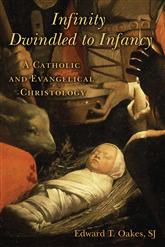
ResizeImageHandler.ashxOn Thursday, April 18, the first ever Lausanne Catholic-Evangelical conversation on mission and evangelism took place at Mundelein Seminary in suburban Chicago. In planning this meeting our Lausanne committee, a group of five which I serve as chairman, agreed that we should have a public lecture/dialogue to begin the private meeting for the three days that we were together, April 18-20. We further agreed that we wanted to address the subject: “Christ Our Center.” The idea for this comes from Dietrich Bonhoeffer and his emphasis upon finding our unity in Christ as Lord of all. I devote an entire chapter in my book, Your Church Is Too Small, to this same topic. So we invited Fr. Edward Oakes, of the Mundelein faculty, to speak to this topic. Dr. Oakes is the author of the excellent book: Infinity Dwindled to Infancy: A Christology for Catholics and Evangelicals (Eerdmans, 2011).

Dr. Hans Boersma, professor at Regent College in Vancouver, was invited to respond. Boersma is the James I. Packer Professor of Theology at Regent. His presentation will be posted next […]

Evangelism, Evangelization and Missional-Ecumenism (4)

By |2021-07-02T06:15:39-05:00May 16th, 2013|Categories: American Evangelicalism, Culture, Current Affairs, Discipleship, Evangelism, Gospel/Good News, History, Kingdom of God, Missional Church, Missional-Ecumenism, Protestantism, Roman Catholicism, The Church, The Future, Unity of the Church|

images-1Over the last three days I have written about evangelism and evangelization, from both a Protestant and Catholic perspective. I have attempted to show the meaning and importance of these respective terms and the theology that lies behind both of them. But what has all of this to do with ecumenism, or with what I call missional-ecumenism?

John Paul II answered my question clearly when he wrote: “How many internal tensions, which weaken and divide certain local churches and institutions, would disappear before the firm conviction that the salvation of local communities is procured through cooperation in work for the spread of the Gospel to the farthest bounds of the earth!” I recognize that the pope was primarily writing about local Catholic parishes but when you see his view fully you will soon realize that he embraced ecumenism as a necessary part of the work of global evangelization.

John Paul II believed that this new evangelization is connected with “entering a new missionary age, [one] which will become a radiant day bearing an abundant harvest, if all Christians, and […]

Evangelism, Evangelization and Missional-Ecumenism (3)

By |2021-07-02T06:15:39-05:00May 15th, 2013|Categories: Culture, Current Affairs, Evangelism, Gospel/Good News, Missional Church, Missional-Ecumenism, Protestantism, Roman Catholicism, The Church, The Future|

Yesterday, I provided the first three major characteristics of Pope John Paul II’s 1990 encyclical Redemptoris Missio. This encyclical spells out the “new evangelization.” My purpose in these blogs is to show how the words evangelism, evangelization and mission are now being used and why a richer, broader and deeper understanding of these words, and what they represent, will help us to do mission in the context of a robust, Spirit-given ecumenism. Today I share three more characteristics of this powerful encyclical.

4. The New Evangelization is directed to individuals and to whole cultures.

Pope John Paul II taught that evangelization includes not only individuals but whole cultures, cultures that need to be transformed by the influence of the gospel. In the missionary activity of the church we will always encounter different cultures thus the church must become involved in the process of inculturation. By inculturation the pope means, “the intimate transformation of authentic cultural values through the integration in Christianity and the insertion of Christianity into the various human cultures.” He adds, “The new evangelization must strive to incarnate Christian values and open the gospel message to human cultures.” […]

Evangelism, Evangelization and Missional-Ecumenism (2)

By |2021-07-02T06:15:39-05:00May 14th, 2013|Categories: Culture, Current Affairs, Evangelism, Gospel/Good News, Missional Church, Missional-Ecumenism, Protestantism, Roman Catholicism, The Church, The Future|

Yesterday, I wrote about the term, and teaching emphasis. which is called the new evangelization within the Catholic Church. I showed how this movement has been building and how it has impacted both Catholics and non-Catholics globally. While evangelicals have historically used the term evangelism modern Catholics prefer this newer word evangelization. There are subtle, and at times profound, differences and we can mutually benefit if we understand these better.

In Redemptoris Missio John Paul II gave some of the characteristics of this new evangelization. In reading more on John Paul II’s initiative I came across a magnificent site called ChristLife. ChristLife is a lay Catholic ministry established in 1995 in response to the Church’s call to a new evangelization. The vision of ChristLife is to equip Catholics for the essential work of evangelization so that others might come to know personally the love of God through Jesus Christ, in the Holy Spirit, becoming his followers and members of the Church.

David Nodar, who serves as the director of CHRISTLIFE Catholic Evangelization Services, an apostolate of the archdiocese of Baltimore (MD), wrote a fine article in which he lists six […]

Evangelism, Evangelization and Missional-Ecumenism (1)

By |2021-07-02T06:15:39-05:00May 13th, 2013|Categories: Culture, Current Affairs, Evangelism, Missional Church, Missional-Ecumenism, Protestantism, Roman Catholicism, The Church, The Future|

imagesThe subject of Christian evangelism notoriously raises problematic questions for those who believe that it is one of the clearest imperatives that Christ gave to his church. Now, in the last few decades, a new term (with slightly different meaning) has arisen: evangelization. In the magnificent and important book, World Christian Trends, AD 30 – AD 2200, by David B. Barrett and Todd M. Johnson (Pasadena, CA: William Carey Library, 2001), we have definitions that can prove to be helpful in understanding these important words and why they matter to earnest followers of Christ today.

Barrett and Johnson make a distinction between evangelism and witness, which I believe to be most helpful. They conclude that evangelism is “the church’s organized activity of spreading the gospel, in circumstances it can control in contrast to witness, which is the normal term for the informal, spontaneous unorganized sharing of the the faith by individual Christians in circumstances they do not control.” Evangelism, by their definition, is an “organized activity” of the church which spreads the gospel. Witness is a “spontaneous unorganized […]

Of What Purpose Is Interreligious Dialogue? (2)

By |2021-07-02T06:15:40-05:00May 10th, 2013|Categories: Current Affairs, Religion, Roman Catholicism|

Evangelical Christians are slow to embrace thinking about dialogue with non-Christians and their religious faith. One profound reason, as we saw yesterday, is our deep fear. We are often fearful that unless we preach the gospel to others we are doing absolutely nothing truly good in the realm of the Holy Spirit.

Another reason for evangelical mistrust of interreligious dialogue is the common belief that all religions are totally and completely false and thus they are only filled with errors and falsehoods. If this is true listening to what they teach us is a complete waste of time. (It seems to me that even if you believed this was true you could still humble yourself and engage with others without feeling that you must tell them, “You are wrong!”)

Perhaps the most obvious reason evangelicals have not engaged in interreligious dialogue, at least until very recently (and this is mostly at the academic level), is that evangelicals embrace a rather narrow view of proclamation which crowds out all other methods of communicaton and warm relationships with other people. if we do not “preach” to others then we feel […]

Of What Purpose Is Interreligious Dialogue? (1)

By |2021-07-02T06:15:40-05:00May 9th, 2013|Categories: Current Affairs, Freedom, Religion, Roman Catholicism|

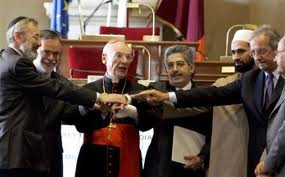
UnknownOne of the great insights of Vatican II was the Catholic Church’s expressed desire for dialogue with non-Christian religions. This insight is generally misunderstood by most evangelicals and rarely appreciated by many Catholics.

As an active ecumenist, working from within the evangelical Protestant world, I always understood that interrelgious dialogue was a form of compromise. Over the past decade or so I have been forced to rethink this matter, knowing full well that some extremely conservative Protestants would react to my change of mind.

It was when I  began to read and understand the teaching of Vatican II that my eyes were first opened to seeing this issue differently. This was because of the sound, clear reasoning of the council. What is affirmed by Vatican Council II is not entirely new but it provided a way forward for Christians to think about non-Christian religions and those who adhere to a belief in God but not to a belief as understood by Christians.

images-1When I visited the Vatican in 2011 I […]