

 One of the great insights of Vatican II was the Catholic Church’s expressed desire for dialogue with non-Christian religions. This insight is generally misunderstood by most evangelicals and rarely appreciated by many Catholics.
As an active ecumenist, working from within the evangelical Protestant world, I always understood that interrelgious dialogue was a form of compromise. Over the past decade or so I have been forced to rethink this matter, knowing full well that some extremely conservative Protestants would react to my change of mind.
It was when I began to read and understand the teaching of Vatican II that my eyes were first opened to seeing this issue differently. This was because of the sound, clear reasoning of the council. What is affirmed by Vatican Council II is not entirely new but it provided a way forward for Christians to think about non-Christian religions and those who adhere to a belief in God but not to a belief as understood by Christians.
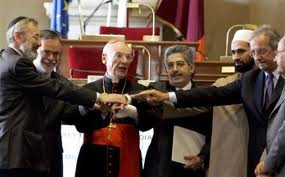 When I visited the Vatican in 2011 I met with leaders in the Pontifical Council for Promoting Christian Unity (PCPCU). This council exercises a double role. It is entrusted with the promotion, within the Catholic Church, of an authentic ecumenical spirit according to the conciliar decree Unitatis Redintegratio (Vatican II). This council carries out this task in liaison with the various departments of the Roman Curia, whose competence includes areas that can contribute similarly to the task of dialogue between the Catholic Church and other churches and ecclesial communities.
The Pontifical Council for Interrelgious Dialogue (PCID) is not the same entity as the PCPCU. It is the central office of the Catholic Church for the promotion of interreligious dialogue, which is also in accordance with the spirit of the Second Vatican Council. This work is particularly related to a declaration of Vatican II called Nostra Aetate. The Council has three primary responsibilities: (1) to promote mutual understanding, respect and collaboration between Catholics and the followers of others religious traditions; (2) to encourage the study of religions; (3) to promote the formation of persons dedicated to
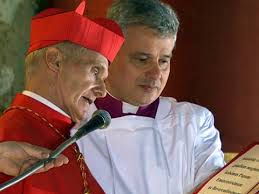 Cardinal Tauran clearly stated what the purpose of the Council is in regard to other faiths. There are some important points that Cardinal Tauran made in this interview, points that help to clarify what the purpose of such dialogue is and why it is important. Inter-religious dialogue is not dialogue between religions! It’s dialogue between religious believers. It’s not a theological or philosophical exercise. It’s goals are limited but they are very important, now more so than fifty years ago. A central reason for such dialogue is the modern world itself. Our world is clearly growing more plural. (Indeed, our own country is becoming more and more plural, a fact that far too few Christians are ready to recognize.) This plurality includes culture, scienctific research, religion and education. The assumption of all such interreligious dialogue is that every human being has a relgious dimension. Cardinal Tauran adds, “Between believers we try first of all to know each other.” But doesn’t this necessarily result in religious compromise thus to an open denial of Christ and his gospel? Cardinal Tauran answers, “The first thing you have to do is to proclaim your faith because you cannot build that dialogue on ambiguity.” Read this sentence again very carefully. Cardinal Tauran is not saying that dialogue is best when we deny what is dictinctive and true about our faith in order to have a conversation with others of a different faith, or even of no faith at all. When we begin to understand one another we can better understand what actually separates us and then what unites us. We can put those things that are common to us at the service of the entire society, thereby promoting peace and human flourishing without denying the importance of our core religious convictions.
Further, such dialogue is not for the consumption of the (believing) community but “it’s at the service of society.” All believers, especially in an increasingly secular West, have a role to play in society. What about Islam? Isn’t it the major problem in the world today? Cardinal Tauran says that Islam is problem number one in the world but the reason for this is because “we don’t know each other.” I profoundly agree with this response, which puts me at odds with many political and religious conservatives. He does not deny the existence of radicalism or terrorism (nor do I) but he believes that many of us “fear” Islam without ever knowing a Muslim neighbor through dialogue and love. This is one reason why it is so important to have this kind of dialogue. What does the Koran actually teach? How do we know? What do Muslims really believe? Why? Are all Muslims alike? What difference does this make?
True dialogue recognizes four modalities. (1) There is a dialogue of life, which is what you have when you live in an apartment building with a Muslim family next door or in a neighborhood that (now) may be more Muslim than Christian. Your neighbors invite you to Ramadan, or you invite them to Christmas, and in so doing you discover everyday life together. (2) There is a dialogue of action. You are the member of charitable organizations or civil unions where we serve together. (3) Where possible there is theological dialogue. Here you try to understand one another and differentiate one religious concept from another. (4) Finally, there is an exchange of spiritual experience. This might happen, to cite but one example, between Christian and Buddhist monks. This dialogue recognizes that what is missing in the world today is interior life and through dialogue we can learn more about what this means to others. Inter-religious dialogue creates a climate of friendship for gaining trust. When you cultivate a true human friendship you have the basis for something better.
Vatican II promoted the idea that there is truth, in various forms, in all religions but never suggested that all roads lead to God or that we are all the same in the end. It did not conclude that all non-Christians were [necessarily] doomed to eternal separation from God, something many conservatives have a hard time processing without misunderstanding. At the same time Vatican II clearly stated that in Christ God was fully and finally revealed in the glory of his divine mystery. Through Christ salvation has come to the world and extends into the world through God’s grace alone.
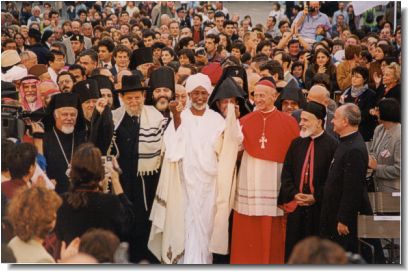 Such dialogue is important because of the mutual concerns that we have around the world for religious freedom. It is a positive thing when we promote freedom together as friends. Are all religious believers equal? They are equal in that they have the same rights, but not they are not equal in the way that they relate to God. We are working toward the truth thus in a limited sense we are equal. But this work does not deny that Jesus is clearly revealed to us “as the way, the truth and the life” (John 14:6). Interreligious dialogue helps us to correct our incredible ignorance and to avoid the constant clash of civilizations. Cardinal Tauran concluded: “We should avoid the clash of ignorances.” Amen.



Addison Hodges Hart liked this on Facebook.
Cheryl Doll liked this on Facebook.
Daniel McDonald liked this on Facebook.
Ed Holm liked this on Facebook.
Willy Hernandez liked this on Facebook.
RT @JohnA1949: Of What Purpose is Inter-religious Dialogue? (1): One of the great insights of Vatican II was the Catholic Churc… http://t…
So good John, I think I will share it! Keep up the good work.
RT @JohnA1949: Of What Purpose is Inter-religious Dialogue? (1): One of the great insights of Vatican II was the Catholic Churc… http://t…