

Evangelical Christians are slow to embrace thinking about dialogue with non-Christians and their religious faith. One profound reason, as we saw yesterday, is our deep fear. We are often fearful that unless we preach the gospel to others we are doing absolutely nothing truly good in the realm of the Holy Spirit.
Another reason for evangelical mistrust of interreligious dialogue is the common belief that all religions are totally and completely false and thus they are only filled with errors and falsehoods. If this is true listening to what they teach us is a complete waste of time. (It seems to me that even if you believed this was true you could still humble yourself and engage with others without feeling that you must tell them, “You are wrong!”)
Perhaps the most obvious reason evangelicals have not engaged in interreligious dialogue, at least until very recently (and this is mostly at the academic level), is that evangelicals embrace a rather narrow view of proclamation which crowds out all other methods of communicaton and warm relationships with other people. if we do not “preach” to others then we feel we have not responded properly.
I believe we can and should engage in interreligious dialogue for reasons I have yesterday. I have been doing this more and more over the last few years. Some of my dialogue is local; i.e. with my neighbors. On several occassions I have engaged in this sort of interrelgious dialogue in formal and public events, showing what Christians and Muslims, to give but one example, believe about the Word of God and how God reveals himself to us.
Nostra Aetate (Latin: In our Age) is the Declaration on the Relation of the Church with Non-Christian Religions adopted by the Second Vatican Council. It was passed by a vote of 2,221 to 88 of the assembled bishops. The declaration was promulgated on October 28, 1965, by Pope Paul VI. It has formed the basis for Catholic dialogue with non-Christians religions for almost forty-eight years now.
 A basic introduction to the thought of Nostra Aetate, which I’ve edited from a Wikipedia entry about the declaration in order to focus on the most basic points, states correctly that the declaration begins by describing the unity of the origin of all people, and the fact that they all return to God; hence their final goal is also one. It describes the eternal questions which have dogged men since the beginning, and how the various religious traditions have tried to answer them. It mentions the answers that (some) Hindus, Buddhists, and members of other faiths have suggested for such philosophical questions. It notes the willingness of the Catholic Church to accept some truths present in other religions in so much as they reflect Catholic teaching and may lead souls to the Christ. Part three goes on to say that the Catholic Church regards Muslims with esteem, and then continues by describing some of the good things that Islam has in common with Christianity and Catholicism; e.g. worship of one God, the creator of heaven and earth, merciful and omnipotent, who has spoken to men; the Muslims’ respect for Abraham and Mary and the great respect they have for Jesus, whom they consider to be a prophet and not God. The synod urged all Catholics and Muslims to forget the hostilities and differences of the past and to work together for mutual understanding and benefit. Part four speaks of the bond that ties the people of the ‘New Covenant’ (Christians) to Abraham’s stock (Jews). It states that even though some Jewish authorities, and those who followed them, called for Jesus’ death, the blame for this cannot be laid at the door of all those Jews present at that time, nor can the Jews in our time be held as guilty, thus repudiating an indiscriminate charge of Jewish deicide; “the Jews should not be presented as rejected or accursed by God.” The Declaration also decries all displays of antisemitism made at any time by anyone.
Note very carefully the words that I have highlighted in this very simple overview. The declaration was not saying that all roads are the same or that all religions contain the same truth. It clearly and plainly states that though there are some “common” truths that Christianity shares with other faiths, especially monotheistic faiths, the ultimate goal of all faith is to come to know the Son of God, Jesus Christ.
It is important to note that the declaration also says very clearly that religious hostilities of the past should be acknowledged and forgotten so that we can work together for “mutual understanding and benefit.” The final part, which deals with common errors regarding the Jews, has proven to be extremely important in modern religious conversation and peacemaking.
Catholic doctrine must of course be presented in its entirety, for “nothing is so foreign to the spirit of ecumenism as a false irenicism, in which the purity of Catholic doctrine suffers loss and its genine and certain meaning is clouded (Unitatis Redintegratio, 11). With this doctrine I agree, namely that “false irenicism” should be rejected.
It is a colossal category error to understand these developments as being the same thing as Christian ecumenism, a mistake too often made by conservative reactions against interreligious dialogue. Christian ecumenism is what I wrote about on Wednesday (May 8).
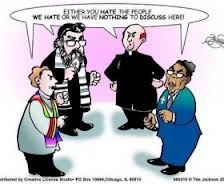 Let me be perfectly clear about the central point. Interreligious dialogue is dialogue between the representatives of Christian churches and representatives of non-Christian religions, which has mutual understanding as its primary goal. While this has sometimes been called the “wider ecumenism” this is a category mistake. This mistake has sown some unfortunate seed that has then been promoted through fear and misunderstanding. Interreligious dialogue does not aim for any kind of visible unity between exclusive truth claims that are in obvious contratiction. Because some progressive Christians promote an ecumenism that wrongly connects these two different conversations much confusion has resulted. Properly speaking the goal of John 17 is “intra-Christian rather than interreligious” dialogue and thus the conversation which has as its clear intent the bringing of Christian brothers and sisters closer together in the one faith revealed in Jesus Christ.
Christian ecumenism is the quest for the visible unity of the currently divided church. This ecumenism, as I noted in my post on Wednesday (May 8), seeks to express our real spiritual unity in outward expressions that unite the various members of the body of Christ in mutual love for Christ and one another.
Opinions about both interreligious dialogue and Christian ecumenism clearly differ, even among Catholics. Many conservative Protestants, and some extremely conservative Catholics, act as if nothing was fundamentally changed at Vatican II. I share the opinion of the famous (Protestant) biblical theologian Oscar Cullman who observed of the Council: “This is more than the opening of a door; new ground has been broken. No Catholic document has ever spoken of non-Catholic Christians in this way.” And no previous document spoke of non-Christian religious conversation in the way Nostra Aetate did.
It is time that we evangelicals listened and learned from this history. I am fully persuaded that understanding this would help us do a better job of sharing the good news in the modern world. Besides this missionary purpose this would help us pursue our role as real peacemakers, something we desperately need in these grave and troubling times.
Related Posts


Comments
My Latest Book!


“Evangelical Christians are slow to embrace thinking about dialogue with non-Christians and their religious faith. One profound reason, as we saw yesterday, is our deep fear. We are often fearful that unless we preach the gospel to others we are doing absolutely nothing truly good in the realm of the Holy Spirit.
Another reason for evangelical mistrust of interreligious dialogue is the common belief that all religions are totally and completely false and thus they are only filled with errors and falsehoods.” I see this is true.
My capstone class for my undergraduate degree dealt with this very theme. It was very refreshing and definitely cultivated a deeper respect for the faith of others while strengthening my own in a manner that didn’t push for everyone in the world to convert to a certain set of beliefs.
Thank you for this post. I agree that it is more crucial than ever to recognize our commonalities with people of other faiths in order to build a better world.
Willy Hernandez liked this on Facebook.
Rosa Edholm liked this on Facebook.
James H Kim liked this on Facebook.
Ed Holm liked this on Facebook.
@JohnA1949 such dialogue is a significant part of what we do. We particularly love our ongoing conversations with Hindu and Muslim leaders.
Waldron Scott liked this on Facebook.
Addison Hodges Hart liked this on Facebook.
Respecting other people’s faith journey is part of loving our neighbors.