

My recent blogs have been devoted to developing a perspective I refer to as missional-ecumenism. I want to show where I believe we are in America today–particularly in terms of the church, culture and our mission. I am a passionate missional-ecumenist. This passion is deeply rooted in three principal texts, all found in the Fourth Gospel; John 13:34-35, 17:20-23 and 20:21. What we discover in the Fourth Gospel is that God is a trinity of loving persons who created humankind in his image. The Father sent the Son into the world to redeem the whole cosmos (cf. Colossians 1:15-20). He is now recreating us by the Spirit, forming a unified redeemed people into a community of faith, hope and love. In this theological paradigm the church is the mission of God (missio Dei), a mission that reveals God’s love as we live faithfully in community. This means the church is not an institution that does mission so much as it is a people who are mission! (This does not mean we ignore missions and missionaries, as some have argued. We must always keep our strong focus on those unreached with the good news.)
Because of the paradigm I see revealed in these three texts in John’s Gospel I humbly submit that ecumenical theology is one of the most pressing needs in our time. I believe this is true precisely because the church that is not profoundly committed to the unity of all the church in Christ’s mission is not seriously committed to the most urgent item of healthy missiology in our century. Let me elaborate.
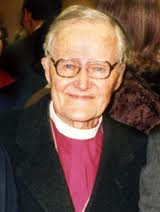 The great missional-ecumenist Lesslie Newbigin concluded more than three decades ago: “It would seem, therefore, that there is no higher priority for the research work of missiologists than to ask the question of what would be involved in a genuinely missionary encounter between the gospel and this modern Western culture” (The Open Secret, 3). With Bishop Newbigin I believe the importance of this subject goes far beyond modern Western nations because globalization is spreading Western culture and religious influence around the world. (This is much more obvious now than when Newbigin first wrote about it as early as the 1960s.) This is especially true in our urban centers where the vast majority of the world’s people now live. It is here where culture is most rapidly changing and where people are hearing and receiving religious faith in new ways. Newbigin wrote an article with the title “Culture of Modernity” in the Dictionary of Mission (1997). In this article he added, “there is no reason for thinking that they
If the gospel is to be liberated from a Western scientific worldview on the one hand, and from fundamentalism on the other, then it would be helpful if we understood how we actually got to this point in Western history. How did the big ideas that drove both modernism and fundamentalism, and both are the product of the same big ideas, become central to the life and practice of the Christian faith? And what can be done to resist these deadly two ditches so that we can actively promote the kind of missional-ecumenism that is centered in the gospel itself, not in our rational propositions about faith and theology?
 Because I am writing primarily for an America audience, though I hope non-Americans will gain insight from this sweeping history of big ideas, I want to begin with the American Civil War. I begin here precisely because during this decisive period of our history both sides, the North and the South, the abolitionists and the non-abolitionists, turned to Christianity to support their public stance. This simple fact indicates just how deeply saturated this nation was by Christian faith. Abraham Lincoln correctly lamented that, “The prayers of both [North and South] could not be answered, that of neither has been answered fully.” What intrigues me is how each side saw the war as a punishment for the nation’s sins. The South, with its much more paternalistic cultural form of Christianity, believed that the sins that brought about this awful war were a result of greedy and avaricious Yankees. The North, married to its ideals of voluntarism and progressivism, laid the blame on the reactionary agrarian slave-owners in the South. Lincoln’s sympathies clearly lay with this northern, liberal ideal of freedom since at Gettysburg in November 1863 he said, “that this nation, under God, shall have a new birth of freedom.” Liberty was delayed, however, for both slaves and women. It wasn’t until the 1960s that the laws of America would begin to seriously liberate African-Americans and women would begin to experience the first profound impact of their increased equality before the law. (There is still room for further improvement.) But in theory liberty reigned supreme in American ideals from the middle of the nineteenth century and it was this concept of liberty itself that was profoundly rooted in a growing form of Christian social thought.
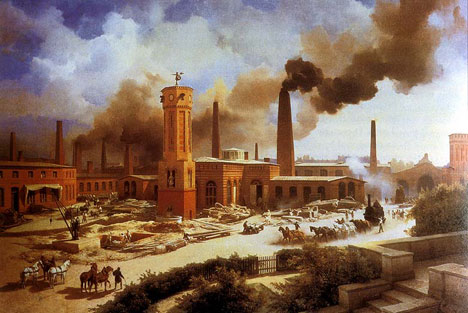 Postbellum America saw the rise of an emerging network of industry – railways, canals, and new forms of industry. All of this shifted the economy from agriculture toward industrial production. This uprooted the population centers from the countryside and moved them more and more to the growing cities, a phenomenon that would continue for the next hundred years. Rapid population growth, along with new waves of immigration, created a working class and a professional middle class. Against this social development Protestantism – America was still a strongly Protestant nation – entered what historians call its “golden age.” Churchgoing reached new levels and by 1870 was at its peak on both sides of the Atlantic, in Great Britain and America. Yet even then in 1870, we have now discovered adequate records that plainly show that women outnumbered men inside the churches, often in significant numbers.
Since very few [women] were allowed to enter ordained ministry, the vast majority had to content themselves with a vocation of domestic care. In a complete reversal of the medieval and Reformation understanding of women, they were no longer regarded as vortexes of barely contained sexual and emotional energy that must constantly be mastered, but as the “weak sex” – kind, gentle, submissive, passive, self-sacrificing and asexual. Men, who were now more likely than women to be regarded as only a step away from being “beasts,” must be protected from their baser instincts by women’s ministrations and good example. Women must have them. Such ideals were communicated not only by male preachers and teachers, but by the thousands of evangelical journals and magazines that were avidly devoured by nineteenth-century women readers. They took vivid shape in stories of virtuous womanhood that figured largely in such literature, in which tales were told of women who, by sheer moral and spiritual force, saved the men they loved from the sinful lives into which they were falling. Their reward, in many cases, was not only a sense of spiritual triumph, but the love of the man they had saved (An Introduction to Christianity, Linda Woodhead, Cambridge University Press, 2004, 250).
Out of this socially changing context sex-roles, at least so far as I understood them growing up in the conservative 1950s, were significantly evolving. This was a development that also unfolded over the course of decades but it would eventually lead many conservative Christian leaders to defend a stereotyped 1950s role for men and women as the biblical model for the role of women. The irony of this reaction is that in earlier centuries in America men and women had shared the household duties. It was only in the growing industrial society that men left home to go to work while women stayed at home and cared for the family. “The churches played a key role in this process, not least in making this contingent state of affairs natural and God-given. . . . mainstream Christianity allied itself with patriarchal interests to develop ideological justification for male exclusion of women from the new economic and spiritual opportunities that presented themselves” (An Introduction to Christianity, 251). Women were now instructed to remain in the home and serve their husbands and children without pay. Working-class women were forced to enter the work place but their jobs resulted in menial pay for their employment. By these developments the more radical Protestant Reformation idea of the “priesthood of all believers” was subverted once again. But the story has only just begun. Tomorrow we will see what all of this meant to theology and mission.
Related Posts


Comments
Comments are closed.


Dan Tomberlin liked this on Facebook.