

 For twenty-seven years Deb Richardson-Moore was a journalist in South Carolina. Then, after being a writer, mother and wife, she entered a Presbyterian seminary (Erskine) to become a Baptist minister. After graduating with her M.Div. she accepted a post at a run-down inner-city church, oddly named Triune. It was a place where the homeless routinely gathered for food and clothing in Charleston, South Carolina. She was, to put it quite mildly, shocked. She thought she knew what she was getting into but within a few weeks reality hit her like the proverbial freight train. Seminary, and life as a mother and professional writer, had not prepared her for this unique calling.
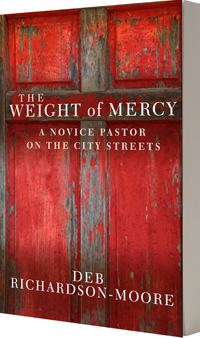
Deb tells her brutally honest and compelling story in a new book with a lovely title: The Weight of Mercy: A Novice Pastor on the City Streets (Monarch, 2012). Her story is told as a personal memoir, a form that has become increasingly popular with modern writers. This allows Deb to relate the story from her perspective, as she recalls it and as she lived it. She admits in the “Author’s Note,” in the front of the book, that, “Other people coming in and out of Triune during these years may have told a different story or many different stories. While all of the stories I tell are true, I have no way of knowing if the stories told to me were true. That, in fact, was my challenge.”
This story is well written, period. It is also profoundly challenging and often extremely humorous. As a child of the Deep South, and as a former Baptist, Deb made me deeply aware of the problems of poverty and race in a profoundly moving, and at times deeply disturbing, way. Because I embrace women in pastoral ministry I particularly loved how she overcame through love and perseverance. This would have been hard work for a man but for a woman it was hard times two.
The question that Deb’s book continually put before me, with such power and civility, was one I’ve pondered for my entire life: “How shall we really help the poor and the homeless?” So much of what we do is well-intentioned but wrong. We believe, for example, that if we give money to a homeless person we are sharing the love of Christ. Deb convinced me that this is true, but up to a critical point. She quickly learned that giving money, even food, has a limiting impact upon the person(s) and the systemic problems that lie behind the reason(s) for homelessness.
The ancient Chinese proverb comes to mind here: “Give a man a fish and you feed him for a day. Teach a man to fish and you feed him for a lifetime.” Give a homeless person cash, food or clothing and they will very often sell these gifts for drugs, barter them for influence or simply take care of an immediate problem for a few hours to only be in a worse condition within a few days. Homelessness, which is a massive problem in the United States, is not solved by government agencies but Deb’s story makes it clear that these agencies have a role to play when they work closely with people and ministries that are really there on the streets with the people. The solution(s) to homeless are not an either/or response but a complex both/and. This is certainly not a conservative/liberal issue either. While political issues are sometimes involved most seasoned veterans of these struggles on the mean streets of America know that the daily life-changing power of love and good news requires people, people who will sacrifice and invest in broken people who have deep needs and very often have deep mental health problems that need the hand of a government agency.
 What Deb Richardson-Moore learned at Triune was that a local church can make a real difference if the people, especially the pastor, will give themselves to help the church become a place of healing and joy. Deb writes, “A whole lot of hurt still walks through our doors. But along with accessing drug rehab or employment assistance, hurting folks may sit down to write a song or paint a canvas and talk to someone who was in the same predicament six months earlier. ‘Hang in there,’ they’re likely to hear. ‘You’re welcome in this place’”(282).
If one quality jumps out at the reader from Deb’s memoir of seven-plus years at Triune it is the power of establishing real trust with people. Her story is a testament to messy grace and the presence of the Holy Spirit in the hard places. Anyone who wants to work among the poor, and do it through the church serving within the community of the poor, would benefit from this easy-to-read, inspiring book.
Related Posts


Comments
Comments are closed.
My Latest Book!


Gary Hubbard liked this on Facebook.
Scott Canatsey liked this on Facebook.
LifeCoach Gwen Griffith liked this on Facebook.