Atonement Demands a Payment

By |2021-07-02T06:15:13-05:00September 16th, 2013|Categories: Uncategorized|

The Scriptures seem to be fairly clear in their teaching about the death of Christ – something like the concept of a payment is involved in Christ’s death for our sins. It is this concept that is at the center of almost every debate on the atonement I know, both historic or modern.

Take the moral influence theory of Christ’s death. This view, originally advocated by Peter Abelard (1079-1142) agreed with Anselm in his rejection of the idea that a ransom was paid to Satan. (We should realize that this notion of paying Satan was a development that grew out of the teaching of early church fathers about Christ’s ransom but it was not the clear and consistent teaching of most of them.) Abelard believed Anselm’s version of satisfaction portrayed God as angry and vengeful. (This concept seems to me to be retained by much of the conservative Reformed community, though it is rejected by most mainstream modern Reformed writers such as T. F. Torrance, etc. )

Abelard’s view was that human beings needed to see the full extent of God’s love so Christ died to reveal the […]

N. T. Wright on Paul and the Faithfulness of God

By |2021-07-02T06:15:13-05:00September 15th, 2013|Categories: Biblical Theology, Books, Justification and the New Perspective, Theology|

If you have followed the theological project of N. T. (Tom) Wright then you will enjoy watching this video and then adding this magnum opus to the other three major volumes. If you do not know what the fuss is about you ought to watch anyway, if for no other reason than to see that Wright is one of the greatest biblical scholars of our time. Those who attack him have rarely read him, at least not carefully. Disagreement that respects his work is very welcome, and some of it is extremely profitable, but please do not resort to ad hominem arguments. Watch this twenty-four minutes and you will appreciate his easy-going human style and profoundly Christian scholarship.

http://youtu.be/sDHs8S1Se3E

What Does Christ’s Victory Mean for Understanding His Death?

By |2021-07-02T06:15:13-05:00September 13th, 2013|Categories: American Evangelicalism, Biblical Theology, Christ/Christology, Church Tradition, Death, God's Character, Gospel/Good News, Kingdom of God, Patristics, Personal, Postmodernity, The Church, The Future|

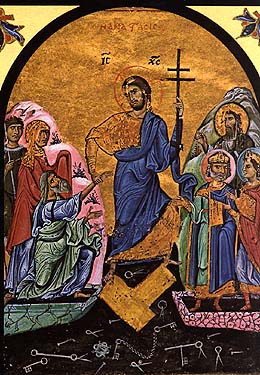
anastas1The New Testament is filled with material concerning the victory of Christ over the powers of evil, a victory finally accomplished, and announced, through his death and resurrection.

One of the seminal texts that comes to mind here is in Matthew’s Gospel.

22 Then they brought to him a demoniac who was blind and mute; and he cured him, so that the one who had been mute could speak and see. 23 All the crowds were amazed and said, “Can this be the Son of David?” 24 But when the Pharisees heard it, they said, “It is only by Beelzebul, the ruler of the demons, that this fellow casts out the demons.” 25 He knew what they were thinking and said to them, “Every kingdom divided against itself is laid waste, and no city or house divided against itself will stand. 26 If Satan casts out Satan, he is divided against himself; how then will his kingdom stand? 27 If I cast out demons by Beelzebul, by whom do your own exorcists cast them out? Therefore they will be your judges. 28 But if […]

How the Enlightenment Took the Church Away from Jesus & Him Crucified

By |2021-07-02T06:15:13-05:00September 12th, 2013|Categories: American Evangelicalism, Biblical Theology, Church Tradition, Faith, Gospel/Good News, Jesus, Kingdom of God, Patristics, Postmodernity, The Church, The Future|

The ancient church did not debate ideas about “appeasing the wrath of God through Christ’s death.” The Christ they worshiped, as we’ve seen, was the victor over the powers. They expressed this in their worship. This can also be discovered in their hymns, in baptism, in their preaching, at the eucharist, and in the recorded prayers of the earliest Christians. It runs like a scarlet thread throughout. If this were understood at all I believe the present evangelical wars about the atonement would be stopped almost instantly.

UnknownMany examples of my point about the early church can be offered but one that has helped me is found in the oldest prayer of thanksgiving we have that was said over the bread and wine in the eucharist. It is the prayer preserved for us by Hippolytus in The Apostolic Tradition, a work written around A.D. 215. This particular prayer points to the theme of Christ’s victory. Here is an important sample of this ancient faith congregational prayer:

Fulfilling your will and gaining for you a holy people, he […]

The Danger of a Book-oriented Approach to Faith

By |2021-07-02T06:15:13-05:00September 11th, 2013|Categories: Uncategorized|

images-1The Book-oriented approach to Christian faith, an approach that became particularly central during the Enlightenment, has several major presuppositions for Christians. Robert E. Webber has underscored the three that I think are worthy of our particular concern.

  1. The Bible is the mind of God written.
  2. The mind is the highest faculty of our creation in the image of God.
  3. Truth is known as the human mind meets the mind of God and this happens in the study of the Scripture.

While I could never have articulated these three concerns this clearly twenty-five years ago I sensed for several decades before that time that something was profoundly wrong with my formative years of theological training at the graduate level in the 1970s. All the time I was debating for inerrancy, and with that debate drawing the subsequent conclusions that most inerrantists hold about the certitude one can have so long as your arguments are rooted in careful biblical exegesis, I had a growing doubt about this foundation.

The idea behind this approach is simple really – the Bible as observable data is an […]

Ancient-Future Faith: What Has It to Do with the Atonement?

By |2021-07-02T06:15:13-05:00September 10th, 2013|Categories: American Evangelicalism, Biblical Theology, Christ/Christology, Forgiveness, God's Character, Jesus, Patristics, Reformed Christianity, The Church, The Future, Theology|

img085

The Holy Spirit seems to be working new convictions –based on ancient ideas about God, Christ and the Holy Spirit – into the younger evangelical generation. My generation was attracted to the details of mastering a theological system and often thought in either/or terms about what was true and false. I was trained by evangelicals who were drawn to the details of theological debate while they were (often) passive about social concerns like peace, war and justice. My generation of evangelicals gave us the Moral Majority and a host of culture warrior Christian spokesmen. (They were mostly “males” so I use the word “men” here intentionally!) My formal training was shaped by science, philosophy, and communication theories. We built churches that were attractional and shaped by programs that fed (not always intentionally) our consumerism. The new generation is geared toward change and dynamic ways of expression. (These are generalizations, I admit, but they are helpful when understood correctly.)

Well over a decade now my late friend Robert E. Webber wrote, “The kind of Christianity that attracts the new […]

How Shall We Understand the Atonement?

By |2021-07-02T06:15:13-05:00September 9th, 2013|Categories: American Evangelicalism, Biblical Theology, Church History, Church Tradition, Jesus, Patristics, Reformed Christianity, The Church, Theology|

814099_5It must be stated, before we even consider several of the ways Christians have traditionally understood the atonement (the meaning of Christ’s death) and its relationship to our sin(s), that all Christians believe this great central truth – Christ’s death reconciles us to God. Whatever else you read, or think you hear me saying in the next few days, please return to this statement and believe me when I say I stake my entire salvation on the death of Christ for my sins.

The word atonement is itself an English translation, as several noted in their comments on my posts last week. But the word atonement is not a bad word because it is an English translation, even though it is a word far too easily misunderstood. That Christ gave his life as a ransom for mankind’s sin is crystal clear in the teaching of Jesus (cf. Matthew 20:28; Mark 10:45). What is not nearly so clear is what this ransom (sacrifice) means. This is especially true in terms of the payment that was made and the person […]

The Atonement Debate: “Why Did Christ Die?” Part 5

By |2021-07-02T06:15:14-05:00September 6th, 2013|Categories: American Evangelicalism, Biblical Theology, Christ/Christology, Creeds, Current Affairs, Death, God's Character, Love, Missional Church, Protestantism, Scripture, The Church, The Future|

JesusOnCrossMake no mistake about this a serious debate about the nature of God’s wrath, and the doctrine of penal satisfaction, is extremely important for many conservative Protestants.  Some of this heat, so I believe, is a carry-over from the earlier battles of fundamentalism with theological liberals who wanted to have a God who loved all and accepted all into his redeemed family.

The recent attempt by the Presbyterian Committee on Congregational Song to change the words of a popular modern hymn (“the wrath of God was satisfied” was to be changed to “the love of God was magnified”) touched off a new debate about defining the atonement in terms of God’s wrath and Jesus’ death as the sacrifice that appeases his wrath. (Some Catholic theologians agree but their position is more encompassing of other ideas and distinctly more nuanced. The Orthodox, as I’ve briefly indicated, take a different view.)

images-2Al Mohler Jr., president of Southern Baptist Theological Seminary, provided USA Today some context to his concerns when he said this […]

World Evangelical Alliance Secretary Urges Religious Liberty for Arab Christians and Non-Intervention Militarily in the Region

By |2021-07-02T06:15:14-05:00September 5th, 2013|Categories: America and Americanism, Current Affairs, Politics|

WEA Secretary General Urges Religious Liberty for Arab Christians at Conference in Jordan
images-1New York, NY – September 5, 2013

On September 3rd and 4th, 2013, Dr. Geoff Tunnicliffe, Secretary General of the World Evangelical Alliance (WEA), spoke at a conference in Amman, Jordan, convened by King Abdullah II ibn al-Hussein to address ‘the challenges facing Arab Christians,’ in particular the situation in Syria and Egypt. Representatives of various churches in the region were invited to ‘unite and give voice to the leadership of Arab Christian Churches (…) and, together, to discuss and find possible solutions.’ In his speech, Dr. Tunnicliffe addressed the increasing suffering and persecution of Arab Christians in recent years, stating that “this is despite the fact that Arab Christians have been loyal citizens in all the countries of the Arab world for two thousand years.”He emphasized the importance of religious freedom for a prospering society and that “Christians in the Arab world deserve to be treated respectfully and with honor.” He said: “All they ask is to be allowed to live in peace […]

The Atonement Debate: “Why Did Christ Die?” Part 4

By |2021-07-02T06:15:14-05:00September 5th, 2013|Categories: American Evangelicalism, Biblical Theology, Creeds, Current Affairs, Death, God's Character, Protestantism, The Church|

imagesThe contentious issue in the current atonement debate among conservative evangelical Christians centers around various doctrinal distinctions that have been important for several centuries. Most conservative preaching has spoken of Christ’s death as meeting God’s just requirement for the punishment of sin, a death that satisfies God’s wrath against mankind’s rebellion. A central text employed by this argument can be seen in Paul’s argument about the ministry of reconciliation in Second Corinthians.

16 From now on, therefore, we regard no one from a human point of view; even though we once knew Christ from a human point of view, we know him no longer in that way. 17 So if anyone is in Christ, there is a new creation: everything old has passed away; see, everything has become new! 18 All this is from God, who reconciled us to himself through Christ, and has given us the ministry of reconciliation; 19 that is, in Christ God was reconciling the world to himself not counting their trespasses against them, and entrusting the message of reconciliation to us. 20 So we are ambassadors for Christ, […]