John Hagee: Reflections on My Facebook Post (Part 3 of 4)
By |2021-07-02T06:13:37-05:00April 9th, 2015|Categories: ACT 3, America and Americanism, American Evangelicalism, Church History, Current Affairs, Eschatology, Evangelism, Hermeneutics, Israel, Kingdom of God, The Church, The Future|

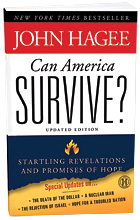
B166PIn the case of John Hagee very few people within the larger culture are paying attention to his prophecies. Last week I scanned a copy of John Hagee’s book, Can America Survive?: 10 Prophetic Signs That We Are The Terminal Generation (Howard Books, 2010), in a Half-Price Bookstore near home. The copy I looked at was called an “Updated Edition.” (I love how these books have to be updated. I wonder why? This is humor dear reader!) The subtitle on this newer edition reads: “Startling Revelations and Promises of Hope.” The cover speaks of “special updates” on: the death of the dollar, a nuclear Iran, the reaction of Israel, and hope for a troubled nation. Hagee writes of the following:

  1. The impending nuclear war in the Middle East
  2. The coming death of the U. S. dollar
  3. The consequences of rejecting Israel
  4. The absolute accuracy of biblical prophecy
  5. The coming Fourth Reich

The dust jacket of this same book says, “As a candid conservative Christian leader . . . this bestselling author courageously sounds an alarm to awaken the American nation from the slumber […]

John Hagee: Reflections on My Facebook Post (Part 2 of 4)

By |2021-07-02T06:13:37-05:00April 8th, 2015|Categories: ACT 3, America and Americanism, American Evangelicalism, Church History, Current Affairs, Eschatology, Evangelism, Hermeneutics, Kingdom of God, The Church, The Future|

So what did Jesus teach about his coming again and the End?

UnknownWe read the words of Jesus in Mark 13:32-37. These are often read as words about this age and his coming again:

“But about that day or hour no one knows, neither the angels in heaven, nor the Son, but only the Father. Beware, keep alert; for you do not know when the time will come. It is like a man going on a journey, when he leaves home and puts his slaves in charge, each with his work, and commands the doorkeeper to be on the watch. Therefore, keep awake—for you do not know when the master of the house will come, in the evening, or at midnight, or at cockcrow, or at dawn, or else he may find you asleep when he comes suddenly. And what I say to you I say to all: Keep awake.”

Most of you know that these various biblical texts referring to Jesus’ return are in the three synoptic Gospels. Parallel to Mark’s Gospel we thus read in Matthew 24:29-31:

“Immediately after the suffering of those days […]

John Hagee: Reflections on My Facebook Post (Part 1 of 4)

By |2021-07-02T06:13:37-05:00April 7th, 2015|Categories: ACT 3, America and Americanism, American Evangelicalism, Church History, Current Affairs, Eschatology, Evangelism, Hermeneutics, Kingdom of God, The Church, The Future|

Several days ago I posted a comment about John Hagee on my Facebook wall. Hagee is a New York Times best-selling author and pastor from San Antonio, Texas. In this comment I posted a link to a site that was critical of Hagee about his growing predictions of “the end of the world.”

PastorJohnHagee_resizedJohn Hagee is the founder and senior pastor of Cornerstone Church in San Antonio, Texas, a non-denominational evangelical church with more than 19,000 active members. He is the founder and chairman of Christians United for Israel. (Note this as I will reference it again later.) He is also the president and C.E.O. of John Hagee Ministries, which telecasts his national radio and television ministry throughout America and can be seen weekly in 99 million homes and in more than 200 nations worldwide.

John Hagee graduated from Trinity University in San Antonio, Texas, then earned his Masters Degree from North Texas University. He received his Theological Studies from Southwestern Assemblies of God University and an Honorary Doctorates from Oral Roberts University, Canada Christian College, and from Netanya Academic […]

Aaron Niequist: The Practice – Learning the Unforced Rhythms of Grace

By |2021-07-02T06:13:38-05:00April 6th, 2015|Categories: Church Tradition, Discipleship, Faith, Missional Church, Missional-Ecumenism, Personal, The Church, The Future|

Aaron Niequist began an experimental community at Willow Creek early last year (2014).

The Practice: Learning the Unforced Rhythms of Grace. Aaron aims to be a discipleship-focused, formation oriented, practice-based tribe asks two simple questions:

(1) What is the Life that Christ invites us into? and (2)

“What are the practices,” he asks, “that we can do together, and on our own, to embrace this Eternal Life now?”

Said simply: What is God doing and how can we join Him?

As Aaron and I have gotten to know each other as good friends the last two years I have watched these developments with increased joy and interest. Today I would like to share some exciting video material with you as my friends. This material is available here for only one week so please watch it now.

On a Sunday night in May, Father Michael Sparough, SJ, guided The Practice community through the historic Christian practice of The Examen. The night was powerful and so unexplainably holy that we wanted to invite more people into the experience. So we’ve turned the live recording of Fr Michael into a full New Liturgy—fleshing it out with an evocative musical score and three original songs. We hope it helps you connect with God in a deep and daily way.

Here is the promo for examen:

Check out the full examen liturgy project here.

Remember, you can only see this for one week so take advantage of it now and […]

Steve Bevans: A Missional-Ecumenist Catholic Theologian

By |2015-04-03T14:58:09-05:00April 1st, 2015|Categories: ACT 3, Missional-Ecumenism, My Christian Unity Story, Personal, Roman Catholicism, The Church, Theology, Unity of the Church|

Stephen Bevans is Louis J. Luzbetak, S.V.D., Professor of Mission and Culture. He is a Roman Catholic priest in the Society of the Divine Word, an international missionary congregation, and served for nine years (1972-1981) as a missionary in the Philippines. He has been on the Catholic Theological Union faculty for 26 years. He is also a very dear friend to me and the work of ACT3 Network.

Steve’s publications include: Models of Contextual Theology (2002), Constants in Context: A Theology of Mission for Today (2004, with Roger Schroeder), Evangelization and Freedom (2009, with Jeffrey Gros), An Introduction to Theology in Global Perspective (2009), Prophetic Dialogue: Reflections on Christian Mission Today (with Roger Schroeder, 2011). In 2012 Steve edited Mission and Culture: The Louis J. Luzbetak Lectures. All of Steve’s books are works of mission, ecumenism and deep reflection on God and the Word.

Steve is also the past president of the American Society of Missiology (2006) and past member of the board of directors of the Catholic Theological Society of America (2007-2009). In March, 2012 Steve was part of the official Vatican delegation to the assembly of the Commission on World Mission and Evangelism in Manila, Philippines. He has taught and lectured in the UK, Australia, New Zealand, Mexico, Italy, Ireland, Taiwan, Ghana, Thailand, and Hong Kong.

I […]

The Lord’s Supper: A Roman Catholic and Reformed Evangelical Dialog (Video)

By |2021-07-02T06:13:38-05:00March 31st, 2015|Categories: ACT 3, Biblical Theology, Church Tradition, Missional-Ecumenism, My Christian Unity Story, Personal, Protestantism, Reformed Christianity, Roman Catholicism, Sacraments, The Church|

Who should participate in the Lord’s Supper? How frequently should we observe it? What does this meal mean? What happens when we eat the bread and drink from the cup? What do Christians disagree about and what do they hold in common? These and other questions are explored in my book, Understanding Four Views of the Lord’s Supper. 51Uh-nniC6L._AA160_This volume in the Counterpoints series from Zondervan allows four contributors to make a case for the following views: • Baptist view (memorialism) • Reformed view (spiritual presence) • Lutheran view (consubstantiation) • Roman Catholic view (transubstantiation) All contributors use Scripture to present their views, and each responds to the others’ essays. This book helps readers arrive at their own conclusions. It includes resources such as a listing of statements on the Lord’s Supper from creeds and confessions, quotations from noted Christians, a resource listing of books on the Lord’s Supper, and discussion questions for each chapter to facilitate small group and classroom use.

After this book was published in 2007 I engaged with my friend Fr. Thomas Baima in a […]

The Church: Ever Ancient

By |2021-07-02T06:13:38-05:00March 30th, 2015|Categories: Culture, Current Affairs, Missional Church, The Christian Minister/Ministry, The Church|

photoThe church is one of the only places in culture where people of multiple generations make our lives together. This is the way God wants it. Augustine addresses God in prayer this way: “Beauty ever ancient, ever new.” I think here of an early church martyr named Polycarp who was ordered by the Romans to curse Christ. “I have followed him eighty-six years and he has done me no wrong. How can I curse my king who saved me?” I think too of John the Baptist leaping in his mother Elizabeth’s womb. The church stretches from the not-yet-born to those on the cusp of the next life.

This is also really difficult. Younger and older folks often struggle to understand one another. We all know this in our own families. Why would we think the church would be any different?

Yet it is crucial that all ages become God’s church together. Scripture promises that Israel’s “sons and daughters shall prophesy, your old men shall dream dreams and your young shall see visions” (Joel 2:28). This is fulfilled in the […]

Difficult Men: Why Did Cable Television Produce So Many Great Works of Popular Art? Part 2

By |2021-07-02T06:13:40-05:00March 26th, 2015|Categories: Books, Culture, Current Affairs, Film, Personal, Television|

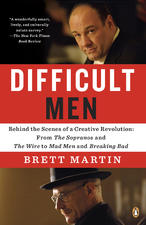
61wQB1+4LXL._UX250_Brett Martin identifies a first burst of literary energy in 1950s television (when the medium was young) and a second that came in the 1980s (when the forward-thinking television executive Grant Tinker’s MGM Enterprises begat the groundbreaking Hill Street Blues). These are followed by the “Third Golden Age,” beginning with The Sopranos. This story is at least half the content of his book. He uses it to set the stage for understanding what followed in shows that may be even better than The Sopranos. The Emmy Awards, given for the best programming in television, are now routinely given only to cable shows such as these, all of which have garned an incredible number of such awards. The New York Times book review of Martin’s books says that he “writes with a psychological insight that enhances his nimble reporting.” Again, I have to agree completely.

Martin takes the reader (listener) behind the scenes of this cultural shift and provides extensive reporting based on interviews and good research. He gives you “never-before-heard” stories and reveals how cable television has distinguished itself […]

Difficult Men: Why Did Cable Television Produce So Many Great Works of Popular Art? Part 1

By |2021-07-02T06:13:40-05:00March 25th, 2015|Categories: Books, Culture, Current Affairs, Film, Personal, Television|

cover225x225As a true fan of what Brett Martin calls “The Third Golden Age” of television I devoured his new book, Difficult Men: Behind the Scenes of a Creative Revolution: From The Sopranos and The Wire to Man Men and Breaking Bad. I devoured the book by listening to Martin’s work as an audio book. Listening to a book in its entirety is a first for me. This one was very easy to listen to since I used long driving stretches to work thorugh it in only a few days. The essential core of Martin’s story was easy to grasp. The actual reader, Keith Szarabajka, was also fantastic, making the aural experience deeply satisfying. (I am told my own book, Your Church Is Too Small, is poorly read in its audio version since the reader apparently does not understand important words and thus mispronounces a number of them. O bother!)

In the late 1990s, and early 2000s, the landscape of television began a transformation with a wave of new shows, all featured on cable channels. The reality is that […]

From John F. Kennedy to John Kerry: Evangelicalism’s Shifting Position on the Catholic Church

By |2021-07-02T06:13:40-05:00March 24th, 2015|Categories: ACT 3, American Evangelicalism, Current Affairs, Missional-Ecumenism, Protestantism, Roman Catholicism, The Church, The Future, Unity of the Church|

Raith_ChadCurrently, at First Things magazine, Dr. Timothy George, Fr. Thomas Guarino and Dr. Carl Trueman are posting reflections on the ecumenical working group Evangelicals and Catholics Together (ECT) in light of their twenty years of existence (see http://www.firstthings.com/web-exclusives/2015/03/evangelicals-and-catholics-togethertwenty-years-later).

The creation and success of ECT was made possible due to a larger shift in evangelical perceptions of Catholicism that had occurred over the course of about sixty years. For me, nothing captures this shift better than the about-face reflected in two Christianity Today editorials addressing the two Roman Catholic presidential candidates, John Kennedy and John Kerry. While the first editorial warns evangelical voters of the candidate’s Catholic faith, the second laments that his faith isn’t strong enough.


When John F. Kennedy announced his run for President of the United States on January 2, 1960, he thrust into the political spotlight something that proved to be as controversial as any policy position, namely, his Catholicism. For many evangelical Christians at the time, this fact alone rendered him a problematic candidate for the office of the presidency.

By the time Kennedy ran for president, there was in place a long history of negative […]