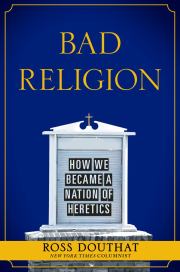
American Christianity at Mid-Century
In writing about the religious conditions in the nation at the middle of the last century Ross Douthat says, “the most striking features of [this revival] are the ways in which mass-market faith and highbrow religiosity seemed to complement each other.” Religious stirrings on college campuses, which I personally experienced more than a decade after the time that Douthat writes about in Bad Religion, united with a surge in church attendance, were evident for all to see. The “social climate for religious living” and “the intellectual climate for religious thinking” became much more congenial following World War II. To quote Douthat, “A kind of Christian convergence was the defining feature of this era. In the postwar revival, the divided houses of American Christendom didn’t just grow, they grew closer together, reengaged with one another after decades of fragmentation and self-segregation.”
There were four figures who embodied his time of convergence. The intellectual giant was Reinhold Niebuhr, a public theologian who was taken seriously by people of all stripes and backgrounds. The revivalist was Billy Graham. Graham’s style is accurately described as “ecumenical, openhanded, confident, American.” He was […]