The Lausanne Catholic-Evangelical Conversation 2014 (2)

By |2021-07-02T06:13:44-05:00January 20th, 2015|Categories: ACT 3, Evangelism, Friendship, Missional-Ecumenism, Personal, Protestantism, Roman Catholicism, The Church, The Future, Unity of the Church|

During the days of September 11-13, 2014, twenty-six people from Catholic and evangelical churches gathered to build relationships for the sake of Christ’s mission. Yesterday I shared the first portion of our report. Today I share the second part of our document.


Relationships for the Sake of the Mission

The 2014 Lausanne Catholic-Evangelical Conversation

Part Two

Nate Bacon suggested the Emmaus Road dialogue as a model of evangelization.  In the context of sharing their pain, disappointment, and devastation the two disciples invited Jesus into their conversation, as did the disciples who Jesus sent out two by two, appearing to the townspeople they encounter as homeless people.  In touching the wounds of humanity, we touch the wounds of Christ.  We say to the poor, “we need you.”  We need the poor; we do evangelization because we need to, in order to encounter Christ.

130829 Father Barron-060 2Fr. Barron had previously suggested another way of viewing the church: “the prolongation of the Incarnation through space and time.”   Many were intrigued by this notion, but Suzanne McDonald explained […]

The Lausanne Catholic-Evangelical Conversation 2014 (1)

By |2021-07-02T06:13:44-05:00January 19th, 2015|Categories: ACT 3|

Lausanne-2014-GatheringLast fall the second annual Lausanne Catholic-Evangelical Conversation took place at Mundelein Seminary in Illinois. Twenty-six people, half of whom were from the Catholic Church and half of whom were from evangelical Protestant communities, joined together for a two-plus day dialogue. The opening evening included a public event that was recorded and can be seen on the ACT3 Network site. The 2013 event is also posted as a video on the same website.

Except for this one public meeting on the opening night the dialogue was intentionally informal and private. One of the greatest takeaways was our friendships and open conversation. We do not seek to solve direct problems (per se) or to write a major ecumenical paper. Our goal was to build trust and ask questions in a conversation of genuine love. We believe this is not the only way to address our present disunity but it is a major way, if not the best and first way. If love unites us in Christ then we must seek to experience this love together. This event allowed […]

Why Is There Something Rather Than Nothing?

By |2021-07-02T06:13:44-05:00January 15th, 2015|Categories: Biblical Theology, God's Character, Love, Philosophy|

Philosophers have debated this question for millennia: “Why is there something rather than nothing?” Christians have an answer, indeed the only answer that I believe satisfies both the mind and the heart.

the-love-of-god-tara-ellisIn the distant past there was only God. The ineffable and eternal God, existing in the triune fellowship of the Father, Son and Holy Spirit. He was/is a God of eternal love. God is a triune fellowship of selfless, perfect, other-centered love. Further, there is no conscious life outside of God, the Father-Son-Spirit. God alone constitutes the complete whole of reality.

This is what we confess in the Creed and this really is central to Christian faith: “I believe in God the Father almighty, creator of heaven and earth.”

But in God there was never anything lacking. The picture is perfect. It is one of a ceaseless peace and joy flowing in love within the circle of the three persons in the divine trinity. God did not, simply put, create everything that is because he lacked anything or needed you or me. He created us out of a […]

Suzanne McDonald: A Reformed Theologian On Christian Unity

By |2015-02-11T09:46:45-06:00January 14th, 2015|Categories: ACT 3, Missional Church, Missional-Ecumenism, My Christian Unity Story, The Church, The Future, Unity of the Church|

Dr. Suzanne McDonald is associate professor of historical and systematic theology at Western Theological Seminary in Holland, Michigan. Suzanne is a “new” friend and shared powerfully in our Lausanne Catholic-Evangelical Conversation last fall. Suzanne is a native of Great Britain and completed her Ph.D. at the University of St. Andrews in Scotland. She has a keen mind but a very warm and engaging spirit.

On the Western Seminary website Suzanne describes her life and teaching with these very moving words:

“I’m passionate about teaching theology because of the powerful ways that the Holy Spirit has used studying theology to deepen my relationship with the Triune God and transform my life in Christ. I pray that this will be true for every student, too, so that by doing theology together, we may grow in knowledge and love of the Lord, our ability to share that with others, and our desire to reflect more fully in our lives what we learn of God’s promises and purposes for us and all of creation.”


Faith Energized By Love

By |2021-07-02T06:13:44-05:00January 13th, 2015|Categories: Biblical Theology, Faith, Freedom, God's Character, Love, Personal, Spirituality|

UnknownAs I have been reading and writing on love for more than thirteen months now I am awestruck by so much that is transforming my own  life.

Here is but one example. A Pauline text that has deeply moved me can be read in Galatians 5:1-6:

For freedom Christ has set us free. Stand firm, therefore, and do not submit again to a yoke of slavery.

Listen! I, Paul, am telling you that if you let yourselves be circumcised, Christ will be of no benefit to you.  Once again I testify to every man who lets himself be circumcised that he is obliged to obey the entire law.  You who want to be justified by the law have cut yourselves off from Christ; you have fallen away from grace.  For through the Spirit, by faith, we eagerly wait for the hope of righteousness.  For in Christ Jesus neither circumcision nor uncircumcision counts for anything; the only thing that counts is faith working through love […]

The Week of Prayer for Christian Unity – Praying for What Deeply Matters to Christ

By |2021-07-02T06:13:44-05:00January 12th, 2015|Categories: ACT 3, Current Affairs, Missional-Ecumenism, My Christian Unity Story, The Church, Unity of the Church|

Over the past few weeks I have posted some short video clips of interviews that ACT3 Network conducted in the fall of 2014. These video posts are on this blog site for you to enjoy and also to share with others. They foster the ACT3 Network vision of “empowering leaders and churches for unity in Christ’s mission.” In these videos you will see Catholic, Orthodox and Protestant Christians, lay and ministerial, speak to the theme of unity and explain why it truly matters. In every way these interviews, and these faithful Christians, speak to the truth that I embrace with all my heart. If you love unity and pray for John 17:21 to become a greater reality among Christians in the world today then I think you will be edified and encouraged by these videos.

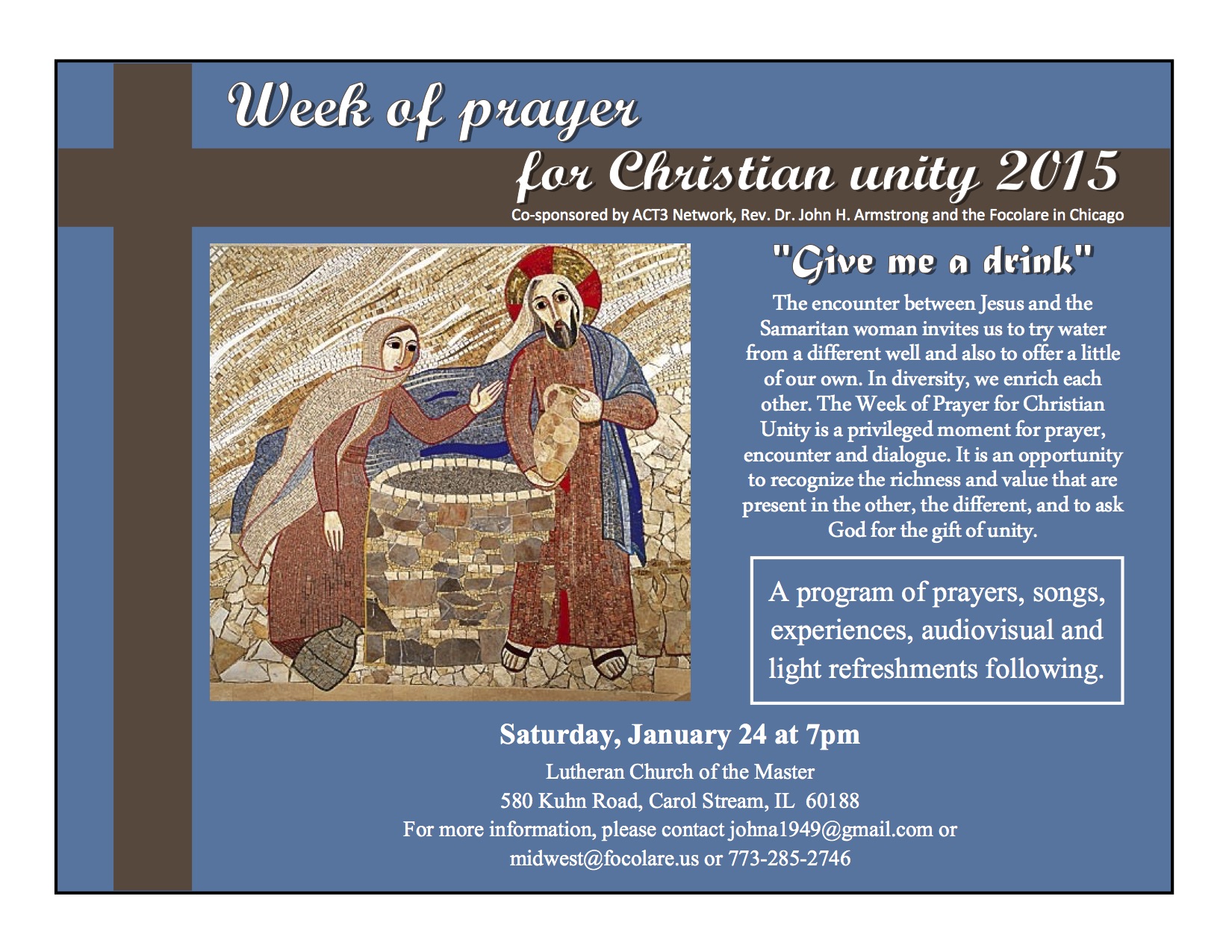
PCU invite 2015On Saturday, January 24, ACT3 Network and the Focolare (a Catholic global lay movement) are co-sponsoring  the Chicago area Week of Prayer for Christian Unity service in Carol Stream, Illinois. The service begins at 7:00 p.m. and will be at Lutheran […]

Lessons from Pope Francis for All Christian Leaders (5)

By |2021-07-02T06:13:44-05:00January 10th, 2015|Categories: American Evangelicalism, Current Affairs, Leadership, Love, Pastoral Renewal, Personal, Renewal, Roman Catholicism, The Christian Minister/Ministry, The Church|

Unknown-1Several years ago Pope Benedict XVI tasked three trusted cardinals to investigate as deeply as necessary the Vatican’s internal culture. He wanted to know what prompted a Vatican butler to steal incriminating documents and then leak them to a journalist. Only two men know what is in the final report that came from this investigation: Pope Benedict XVI and Pope Francis. So on December 22 Pope Francis responded to this internal investigation by addressing the Vatican Curia in a message that was direct, sharply stinging and very bold. In it he gave 15 Ailments of the Curia.

Over the last four days I have counted down each one of these “ailments” from number fifteen to number five. Today I share the last four.

No. 4 Planning too much

The pope said, “Preparing things well is necessary, but don’t fall into the temptation of trying to close or direct the freedom of the Holy Spirit.”

This charismatic Jesuit pope is a man who walks in the Spirit. He loves deeply and especially loves the gospel of forgiveness and joy. He knows the joy […]

Lessons from Pope Francis for All Christian Leaders (4)

By |2021-07-02T06:13:44-05:00January 9th, 2015|Categories: ACT 3, American Evangelicalism, Church Tradition, Current Affairs, Leadership, Personal, Renewal, Roman Catholicism, The Church, The Future|

The “seven deadly sins” are a classical way that the church has defined those particular sins that most clearly kill the work of grace. Pope Francis recently rebuked the leaders of the Roman Curia (12/22/14), the governing leadership team of the Roman Catholic Church, and gave them 15 Ailments that indicted the bureaucracy of the church for its spiritual hypocrisy. These ailments are worthy of more careful consideration whether we are Catholic or not. I am counting these down, with my own comments. Today we see three more of the 15 Ailments.

Unknown-1No. 7 Being rivals or boastful.

Church leaders can easily begin to think that they are the indispensable ones in the church. I read a story a few weeks ago that underscores this for me. A lay Catholic was witnessing and sharing their faith in Christ powerfully and a leader rebuked him for taking the lead in such matters. He was asked, “Under what authority do you do this without the priesthood?” He answered, “Under the authority of some 2,860 bishops of the Catholic Church who clearly […]

Lessons from Pope Francis for All Christian Leaders (3)

By |2021-07-02T06:13:45-05:00January 8th, 2015|Categories: ACT 3, American Evangelicalism, Church Tradition, Current Affairs, Leadership, Personal, Renewal, Roman Catholicism, The Christian Minister/Ministry, The Church, The Future|

UnknownVatican watchers reported (AP), after Pope Francis spoke to the Roman Curia on December 22, that “they had never heard such a powerful, violent speech from a pope and suggested that it was informed by the results of a secret investigation ordered by Emeritus Pope Benedict XVI in the aftermath of leaks of his 2012 papers.”

I believe the ordinary reader does not realize that Pope Benedict XVI was earnestly seeking to reform the Curia for some years. This report grows out of those efforts that he began. Many journalists, with little knowledge of either Pope Benedict or of how the Vatican really works, do not give him the credit that he is due for what he began in earnest. Some have speculated that one reason he stepped down was so that what he began to reform could be carried out by a new “reformer” pope! It seems apparent this reformation is now underway. In Pope Francis we have a pastor of courage and humility who has waded into a mess and seems determined to make a real […]

Lessons from Pope Francis for All Christian Leaders (2)

By |2021-07-02T06:13:45-05:00January 7th, 2015|Categories: Current Affairs, Leadership, Love, Personal, Roman Catholicism, Spirituality, The Christian Minister/Ministry, The Church, The Future|

pope-francis-600Yesterday I reported on the comments that Pope Francis made to the Roman Catholic Curia just prior to Christmas. He enumerated fifteen ailments he saw in the curia. (The term curia is foreign to many evangelicals. The curia consists of those officials who assist in the governance of the Catholic Church. The Roman Curia is the central government of the global Catholic Church.) Other denominations have something like the curia but the origins of this term are generally believed to be found in Latin (Roman) Western developments. For example, every diocese (even in many non-Catholic contexts) has the equivalent of a curia. This governing council can be made up of priests, ministers, financial officers and other lay officers who help govern. Every institutional church form has something like a curia even if we call it the elders or deacons of the church.

The point of all this is to show you that the pope’s strong statements can be applied to all who govern and lead the church, including lay leaders in evangelical contexts. For this reason I am counting down […]