Evangelism, Evangelization and Missional-Ecumenism (3)

By |2021-07-02T06:15:39-05:00May 15th, 2013|Categories: Culture, Current Affairs, Evangelism, Gospel/Good News, Missional Church, Missional-Ecumenism, Protestantism, Roman Catholicism, The Church, The Future|

Yesterday, I provided the first three major characteristics of Pope John Paul II’s 1990 encyclical Redemptoris Missio. This encyclical spells out the “new evangelization.” My purpose in these blogs is to show how the words evangelism, evangelization and mission are now being used and why a richer, broader and deeper understanding of these words, and what they represent, will help us to do mission in the context of a robust, Spirit-given ecumenism. Today I share three more characteristics of this powerful encyclical.

4. The New Evangelization is directed to individuals and to whole cultures.

Pope John Paul II taught that evangelization includes not only individuals but whole cultures, cultures that need to be transformed by the influence of the gospel. In the missionary activity of the church we will always encounter different cultures thus the church must become involved in the process of inculturation. By inculturation the pope means, “the intimate transformation of authentic cultural values through the integration in Christianity and the insertion of Christianity into the various human cultures.” He adds, “The new evangelization must strive to incarnate Christian values and open the gospel message to human cultures.” […]


Evangelism, Evangelization and Missional-Ecumenism (2)

By |2021-07-02T06:15:39-05:00May 14th, 2013|Categories: Culture, Current Affairs, Evangelism, Gospel/Good News, Missional Church, Missional-Ecumenism, Protestantism, Roman Catholicism, The Church, The Future|

Yesterday, I wrote about the term, and teaching emphasis. which is called the new evangelization within the Catholic Church. I showed how this movement has been building and how it has impacted both Catholics and non-Catholics globally. While evangelicals have historically used the term evangelism modern Catholics prefer this newer word evangelization. There are subtle, and at times profound, differences and we can mutually benefit if we understand these better.

In Redemptoris Missio John Paul II gave some of the characteristics of this new evangelization. In reading more on John Paul II’s initiative I came across a magnificent site called ChristLife. ChristLife is a lay Catholic ministry established in 1995 in response to the Church’s call to a new evangelization. The vision of ChristLife is to equip Catholics for the essential work of evangelization so that others might come to know personally the love of God through Jesus Christ, in the Holy Spirit, becoming his followers and members of the Church.

David Nodar, who serves as the director of CHRISTLIFE Catholic Evangelization Services, an apostolate of the archdiocese of Baltimore (MD), wrote a fine article in which he lists six […]

Evangelism, Evangelization and Missional-Ecumenism (1)

By |2021-07-02T06:15:39-05:00May 13th, 2013|Categories: Culture, Current Affairs, Evangelism, Missional Church, Missional-Ecumenism, Protestantism, Roman Catholicism, The Church, The Future|

imagesThe subject of Christian evangelism notoriously raises problematic questions for those who believe that it is one of the clearest imperatives that Christ gave to his church. Now, in the last few decades, a new term (with slightly different meaning) has arisen: evangelization. In the magnificent and important book, World Christian Trends, AD 30 – AD 2200, by David B. Barrett and Todd M. Johnson (Pasadena, CA: William Carey Library, 2001), we have definitions that can prove to be helpful in understanding these important words and why they matter to earnest followers of Christ today.

Barrett and Johnson make a distinction between evangelism and witness, which I believe to be most helpful. They conclude that evangelism is “the church’s organized activity of spreading the gospel, in circumstances it can control in contrast to witness, which is the normal term for the informal, spontaneous unorganized sharing of the the faith by individual Christians in circumstances they do not control.” Evangelism, by their definition, is an “organized activity” of the church which spreads the gospel. Witness is a “spontaneous unorganized […]

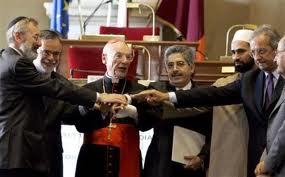
Of What Purpose Is Interreligious Dialogue? (2)

By |2021-07-02T06:15:40-05:00May 10th, 2013|Categories: Current Affairs, Religion, Roman Catholicism|

Evangelical Christians are slow to embrace thinking about dialogue with non-Christians and their religious faith. One profound reason, as we saw yesterday, is our deep fear. We are often fearful that unless we preach the gospel to others we are doing absolutely nothing truly good in the realm of the Holy Spirit.

Another reason for evangelical mistrust of interreligious dialogue is the common belief that all religions are totally and completely false and thus they are only filled with errors and falsehoods. If this is true listening to what they teach us is a complete waste of time. (It seems to me that even if you believed this was true you could still humble yourself and engage with others without feeling that you must tell them, “You are wrong!”)

Perhaps the most obvious reason evangelicals have not engaged in interreligious dialogue, at least until very recently (and this is mostly at the academic level), is that evangelicals embrace a rather narrow view of proclamation which crowds out all other methods of communicaton and warm relationships with other people. if we do not “preach” to others then we feel […]

Of What Purpose Is Interreligious Dialogue? (1)

By |2021-07-02T06:15:40-05:00May 9th, 2013|Categories: Current Affairs, Freedom, Religion, Roman Catholicism|

UnknownOne of the great insights of Vatican II was the Catholic Church’s expressed desire for dialogue with non-Christian religions. This insight is generally misunderstood by most evangelicals and rarely appreciated by many Catholics.

As an active ecumenist, working from within the evangelical Protestant world, I always understood that interrelgious dialogue was a form of compromise. Over the past decade or so I have been forced to rethink this matter, knowing full well that some extremely conservative Protestants would react to my change of mind.

It was when I  began to read and understand the teaching of Vatican II that my eyes were first opened to seeing this issue differently. This was because of the sound, clear reasoning of the council. What is affirmed by Vatican Council II is not entirely new but it provided a way forward for Christians to think about non-Christian religions and those who adhere to a belief in God but not to a belief as understood by Christians.

images-1When I visited the Vatican in 2011 I […]

St. Cyril of Alexandria – Our True Unity Flows from Divine Diversity

By |2021-07-02T06:15:40-05:00May 8th, 2013|Categories: God's Character, Incarnation, Missional-Ecumenism, Patristics, Personal, The Church, Unity of the Church|

Our Lord Jesus Christ did not pray only for his twelve apostles, who became the solid foundation of the Christian church. He also prayed, as we read in John 17:20-24, for all who would believe in him in every age since the apostles. He prayed for all of those who would yield to him and obey the words that call them to be holy by believing on him as the Christ, the son of the living God. We see his will in this matter revealed most plainly in these astounding words:

20 “I ask not only on behalf of these, but also on behalf of those who will believe in me through their word, 21 that they may all be one. As you, Father, are in me and I am in you, may they also be in us,[a] so that the world may believe that you have sent me. 22 The glory that you have given me I have given them, so that they may be one, as we are one, 23 I in them and you in me, that they may become completely one, so that the world […]

Radical Love and Kingdom Generosity (2)

By |2021-07-02T06:15:40-05:00May 7th, 2013|Categories: Discipleship, Ethics, Faith, Kingdom of God, Money & Stewardship, Poverty|

imagesYesterday, I suggested that Luke 6 provides a pattern for how we can live extravagant, generous lives rooted in the love and mercy of God himself. This sixth chapter of Luke has often pushed me to deeper resolve to follow Jesus in his radical love. Let me illustrate this by commenting on a few particular words of our Lord in Luke 6:37-38. I have often prayed over these words and felt it was a great text to teach the liberal giving of our financial support for Christ’s church. I believe it does encourage this practice but I believe it encourages so much more than this when it is deeply considered in meditative prayer. Here are the words of our Lord that I refer to:

37 “Do not judge, and you will not be judged; do not condemn, and you will not be condemned. Forgive, and you will be forgiven; 38 give, and it will be given to you. A good measure, pressed down, shaken together, running over, will be put into your lap; for the measure you give will […]

Radical Love and Kingdom Generosity (1)

By |2021-07-02T06:15:40-05:00May 6th, 2013|Categories: Discipleship, Ethics, Faith, Kingdom of God, Money & Stewardship|

At the very heart of the kingdom message of Jesus is a call to radical love that will not easily go away under convenient readings of the text, readings that fit comfortably with our way of treating people in a modern “Christendom” culture.

We encounter this radical teaching in many parts of the Gospels but no text has redefined my life and actions, time and time again, quite like what I have read in Luke 6. Here is the portion of the sixth chapter that I wish to draw your attention to today:

27 “But I say to you that listen, Love your enemies, do good to those who hate you, 28 bless those who curse you, pray for those who abuse you. 29 If anyone strikes you on the cheek, offer the other also; and from anyone who takes away your coat do not withhold even your shirt. 30 Give to everyone who begs from you; and if anyone takes away your goods, do not ask for them again. 31 Do to others as you would have them do to you.

32 “If you love those who love you, what […]

Same-Sex Marriage Redux (2)

By |2021-07-02T06:15:40-05:00May 3rd, 2013|Categories: Uncategorized|

homoThe question I asked yesterday, put plainly and simply, is this: How shall we proceed in a time when the Christian church is divided over same-sex marriage? We are quite clearly at the place in church history, at least in the West, where Christians clearly do not agree on the issue of homosexual marriage. How shall we then proceed?

The Christian Century, a magazine from the progressive side of Christianity, recently did an editorial in their March 20 issue titled “Blessing Gay Marriage.” They stated:

Inside and outside the church, marriage has long been defined as the lifelong commitment of two people to sharing in all things in life–children, property, money, joys, sorrows, poverty, prosperity. What Christians have added to this general understanding is not an insistence on procreation but rather an insistence that marriage mirrors in some way God’s fidelity to creation and to God’s people.

Am I missing something here? The historical facts, and most Christian advocates of gay marriage agree about this point, are that “the general understanding” among Christians has indisputably been that marriage […]

Same-Sex Marriage Redux (1)

By |2021-07-02T06:15:40-05:00May 2nd, 2013|Categories: Homosexuality, Love, Marriage & Family, Personal, Separation of Church & State, The Christian Minister/Ministry, The Church|

imagesGay marriage is clearly “the great debate” of the hour. People on both sides, and all sides in between, debate the meaning of Scripture’s witness to the covenant of marriage and the role of the state in making civil law. On one side, Christians argue that “gay marriage” is not clearly envisioned in Scripture but the idea itself is acceptable because of how obscure the “proof texts” are regarding same-sex relationships. They argue the idea itself is grace-filled because accepting the sexual practice of a whole group of people who are differently oriented from the majority of us is what grace always does. (Honesty requires that we admit that the Bible does not say a lot about this issue, as advocates of same-sex practice often argue. Yet it seems that what it does say seems fairly clear to most Christians.) So proponents of gay marriage appeal to (virtual) textual silence and to grace. They then argue that marriage is a bond of love between two adults who commit themselves to one another. It is increasingly hard to […]