How Can Unity Be Beyond All Conflict?

By |2021-07-02T06:15:35-05:00June 28th, 2013|Categories: ACT 3, Church Tradition, Current Affairs, Missional Church, Missional-Ecumenism, Protestantism, Roman Catholicism, The Church, The Future, Unity of the Church|

I ended Thursday’s blog with the opening sentence of the second major point made by Pope Francis in his address on unity, given June 18, at the Vatican. His words are so startling as to jar you if you read them and just stop, I mean make a full stop! “Unity is beyond all conflict.” How can this be? What on earth is he talking about? It seems impossible to grasp in any ordinary sense of the words given what we know about church history and modern reality.

But here is what he said, in full, to give the larger context (italics are all mine):

Unity is beyond all conflict. Unity is a grace that we must ask of the Lord so he may save us from the temptations of the division, from internal struggles and selfishness, from gossip. How much damage gossip does! How much damage! Never gossip about others, never! How much damage divisions causes among Christians, bringing partisan, narrow interests into the Church! Divisions among us [i.e. among Catholics], but also divisions among the communities [i.e. ecclesial communities, what we call churches, are […]

Our True and Eternal Unity is in Christ Alone

By |2021-07-02T06:15:35-05:00June 27th, 2013|Categories: ACT 3, Church Tradition, Current Affairs, Missional Church, Missional-Ecumenism, Personal, Protestantism, Roman Catholicism, The Church, The Future, Unity of the Church|

In Pope Francis’ general address on unity, given on June 18 last week, he has two major points. I commented on the first one on Wednesday, June 26. Now I comment on the second. Here is the point that the pope made:

And here I come to a second aspect of the Church as the Body of Christ. St Paul says that as members of the human body, although different and many, we form one body, as we were all baptized by one Spirit into one body (cf. 1 Cor 12:12-13). In the Church, therefore, there is a variety, a diversity of tasks and functions, there is no dull uniformity, but the richness of the gifts that the Holy Spirit distributes. But there is communion and unity: we are all in a relation to each other and we all come together to form one living body, deeply connected to Christ. Let us remember this well: being part of the Church means being united to Christ and receiving from Him the divine life that makes us live as Christians; it means remaining united to the Pope […]

Living in Jesus Is Unity

By |2021-07-02T06:15:35-05:00June 26th, 2013|Categories: ACT 3, Current Affairs, Missional Church, Missional-Ecumenism, Personal, Protestantism, Roman Catholicism, Sacraments, Spirituality, The Church, The Future, Unity of the Church|

7It is incredibly encouraging to read the moving words of Pope Francis on Christian unity that were given to a general audience last week at the Vatican.

Yesterday, I asked how Pope Francis could speak of unity with various other Christians, especially evangelicals, when the Catholic Church confesses itself to be the one, true church. Today I offer my commentary on the first major portion of the pope’s address. Here is what he said:

The image of the body helps us to understand this deep Church-Christ bond, which St. Paul has developed especially in the First Letter to the Corinthians (cf. chap. 12). First, the body brings our attention to a living reality. The Church is not a charitable, cultural or political association, but a living body, that walks and acts in history. And this body has a head, Jesus, who guides, feeds and supports it. This is a point I want to emphasize: if the head is separated from the rest of the body, the whole person cannot survive. So it is in the Church, we […]

If Rome is the One Church How Can Pope Francis Speak of Our Being One in Christ?

By |2021-07-02T06:15:35-05:00June 25th, 2013|Categories: ACT 3, American Evangelicalism, Church Tradition, Creeds, Missional Church, Missional-Ecumenism, Personal, Protestantism, Roman Catholicism, The Church, Unity of the Church|

Yesterday, I shared the general audience address of Pope Francis from last week on Christian unity. Today I would like to offer some simple commentary and explanation of this amazing address.

The pope began his audience by saying:

Today I will focus upon another expression with which the Second Vatican Council indicates the nature of the Church: that of the body, the Council says that the Church is the Body of Christ (cf. Lumen Gentium, 7).

imagesLumen Gentium, in English, means: “The Dogmatic Constitution on the Church.” It is one of sixteen dogmatic documents that make up the whole of Vatican Council II’s work. Lumen Gentium was the third of the sixteen formal documents, or decrees, that were passed by the council between October 1962 and December 8, 1965. Here is a part of that dogmatic constitution cited by Pope Francis last week:

The present-day conditions of the world add greater urgency to this work of the Church so that all men, joined more closely today by various social, technical and cultural ties, might also attain fuller […]

My Vocation for Unity and the Election of Pope Francis

By |2021-07-02T06:15:35-05:00June 24th, 2013|Categories: ACT 3, Current Affairs, Missional Church, Missional-Ecumenism, Personal, Protestantism, Roman Catholicism, The Church, The Future, Unity of the Church|

I am asked continually about Pope Francis, particularly by evangelical Protestants who have traditionally been suspicious of the Catholic Church in general and the pope in particular. I have shared here on this site, for some years now, reports of my growing friendships and unity with my Catholic brothers and sisters.

To put this very simply, and in my own context for this blog site, I believe my personal charism (vocation/calling) is to explain and model Christian unity (John 17) and to build relational and ecclesial bridges that promote and lead to deep unity. Back in the decade of 1990s this vision profoundly gripped my heart. This happened first in my preaching of John 17:20-26 in May of 1992. This was at the same time that I was leaving twenty years of pastoral ministry to serve this new ministry that I began for renewal in 1991. This happened again one Sunday morning at College Church in Wheaton in what I would describe as a Spirit-drenched encounter with the Apostles’ Creed. I had studied the creeds and was simply reciting it when the Holy Spirit fell on me […]

Max Boot's "Twelve Articles" on Guerrilla Warfare and Terrorism

By |2021-07-02T06:15:36-05:00June 21st, 2013|Categories: Books, History, Politics, Spiritual Warfare, The Future, The War on Terrorism|

Colonel Roger Trinquier (1961) said, “We . . . attack an enemy who is invisible, fluid, uncatchable.” Perhaps no statement included in Max Boot’s masterful history of guerrilla and terrorist warfare better sums up what we have faced since 9/11.

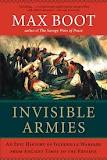
imagesHistorian Max Boot concludes his massive tome on guerrilla and terrorist warfare with a postscript called: “The Lessons of Five Thousand Years.” In 1917 T. E. Lawrence wrote an essay called “Twenty-Seven Articles” which summed up many of the lessons that he had learned as an insurgent fighter. Boot provides twelve articles that sum up the lessons we can learn from Invisible Armies. I will not develop each one extensively but provide some brief comments.

1. Guerrilla Warfare has been ubiquitous and important throughout history.

Much of the world’s population lives in states whose current boundaries and forms of government were determined by insurgencies waged by or against their ancestors. This is not just true in the two-thirds world. Think of the United Kingdom. It is united because the English defeated the Scottish and Irish insurgencies. America is united because […]

Invisible Armies: An Epic History of Guerrilla Warfare from Ancient Times to the Present

By |2021-07-02T06:15:36-05:00June 20th, 2013|Categories: Books, Current Affairs, History, Politics, The Future, The War on Terrorism|

UnknownMax Boot’s new book, Invisible Armies (New York: W. W. Norton, 2013), presents an encyclopedic survey of guerrilla warfare in a readable, vivid narrative that has to be the comprehensive work on the subject. I confess that I would never have read a book on modern warfare had it not caught my eye on the “New Non-Fiction” shelf in my public library. But there it was – “speaking to me”– so I decided to give it a go. I did not read it word-for-word, and frankly felt no desire to do so since I did not buy the book @ the list price of $35.00. (This is one of the many advantages of using the library since I do not feel “guilty” when I dip into such a big book and browse only what truly interests me!) End notes and text make the book come to exactly 750 pages!

Max Boot is the Jeane J. Kirkpatrick Senior Fellow in National Security Studies at the Council on Foreign Relations. He is a regular contributor to the Wall Street Journal, and […]

Why Has the Missional Movement Not Pursued Ecumenism More Seriously?

By |2021-07-02T06:15:36-05:00June 19th, 2013|Categories: ACT 3, American Evangelicalism, Discipleship, Kingdom of God, Missional Church, Missional-Ecumenism, The Church, Unity of the Church|

In yesterday’s blog I wrote in the final paragraph:

Only in unity can we remove the scandal of our myriad schisms and heal our frequent divisions, divisions that destroy our witness to the world of the 21st century. Dialogue may not get us to where we need to be, at least not by itself, but it has to be the first-step. We share so much more in common than we disagree upon and we will only regain power in the public square when we speak as ONE. A new reality, one less political and angry, can emerge if we will pray together, love one another and radically seek what Jesus prayed for in John 17:21.

I pick up today where I left this off yesterday by asking a very direct question to those who promote “missional” theology as I fervently do? Question: Why has the missional movement, with all of its good and proper emphasis upon the church as the mission of God, not yet discovered the power of visible, catholic unity? Why is ecumenism not a serious priority inside the missional theology movement? I read […]

Why Dialogue Matters to Our Unity in a Secular Culture

By |2021-07-02T06:15:36-05:00June 18th, 2013|Categories: ACT 3, American Evangelicalism, Church Tradition, Creeds, Culture, Discipleship, Missional-Ecumenism, Protestantism, Roman Catholicism, The Church, The Future, Unity of the Church|

UnknownIn my post yesterday I showed that the lack of Christian unity has profoundly contributed to the rise of secularism in the West. I argued that this was particularly true in the United States. Today I want to show you why this is the case.

When the Irish Catholics arrived in America in the mid-19th century there was a deep-seated bias against them, a bias promoted by a virulent form of anti-Catholicism that had been engrained in the American mind and heart from its origin. This bias led these two expressions of Christ’s presence to live in “solitudes” of cultural isolation. Over time the Irish would gain acceptance in major American cities; e.g. Boston, New York and Chicago. The Irish served gallantly in the Civil War, on the side of the North, and eventually entered mainstream society. They became extremely proud of their heritage and culture, for good reason. They were great Americans! (In Chicago, where I live, St. Patrick’s day is a huge celebration, one which includes a parade where all the politicians take part. The Chicago […]

Our Lack of Unity Fuels Secularism

By |2021-07-02T06:15:36-05:00June 17th, 2013|Categories: ACT 3, American Evangelicalism, Church History, Culture, Missional-Ecumenism, The Church, The Future, Unity of the Church|

images-1Last week I shared in several ecumenical events in Chicago. I will write more about these events in the next few weeks. I think they reveal what happens when God’s people listen to one another with love and respect and what potential there is for the future of the church in our increasingly secular culture.

What stands behind my personal interests, as my regular readers know well, is my vision/vocation, a vocation that sprang from God capturing my mind and heart through the words of our Lord in John 17:20-26.

I have included these words as translated by the late J. B. Phillips in the Phillips New Testament.

I am not praying only for these men but for all those who will believe in me through their message, that they may all be one. Just as you, Father, live in me and I live in you, I am asking that they may live in us, that the world may believe that you did send me. I have given them the honor that you gave me, that they may […]