A Baptist Minister Drawing Lessons from Pope Francis

By |2021-07-02T06:14:59-05:00December 17th, 2013|Categories: American Evangelicalism, Current Affairs, Homiletics/Preaching, Leadership, Personal, Roman Catholicism, Spirituality, The Christian Minister/Ministry, The Church|

Bob Baker editedIn late October I visited with Michael and Nancy Ristau, two dear friends who live in Lexington, Kentucky. I met Michael while speaking on a mens’ retreat for several churches in California years ago. Michael and Nancy are like other people I’ve met in my travels here and there, persons who feel drawn to form a deep and growing friendship with me. Michael and Nancy, along with their lovable German shepherd Quincy who tolerates me, have grown in Christ’s love for me and vice versa. I have twice visited the Ristau’s lovely home and stayed for several days as their honored guest. Their hospitality is real and they are so easy to spend time with because their home is a comfortable context. They place no demands on me or my daily life.

This recent trip included a visit to Asbury Seminary, where I shared the work of the Acton Institute with faculty. I also saw Alabama play Kentucky on a lovely Saturday evening at Commonwealth Stadium in Lexington.

On a previous visit to Lexington I attended Calvary […]

Philomena – A Film That Reveals Gospel Grace and Forgiveness

By |2021-07-02T06:14:59-05:00December 16th, 2013|Categories: Current Affairs, Feminism & Women, Film, Forgiveness, Gospel/Good News, Personal, Roman Catholicism, Sexuality, The Church|

220px-Philomena_posterI saw the new movie Philomena last week. I was unprepared for how much this film would move me to the depths of my spirit. It is my “sleeper” film for 2013! I noted this weekend, with great joy, that it was nominated for the Golden Globe as “Best Picture.” (There are only five nominees. The Academy now has ten nominees and if Philomena is not nominated someone should investigate the process!)

Philomena is a 2013 British film based upon the book The Lost Child of Philomena Lee, written by Martin Sixsmith. (Martin Sixsmith was the reporter who helped Philomena search for her lost son.) The film tells the true story of Philomena Lee’s 50-year-long search. The book focuses more, as the title suggests, on the life of Michael/Anthony (Philomena’s son) after his adoption in Ireland. The film focuses more on Philomena herself yet it gives us a clear picture of what transpired in Michael/Anthony’s life over the years since he was taken from the convent in Ireland.

As the film begins Martin Sixsmith has just lost his job […]

Sandy Hook School One Year Later

By |2021-07-02T06:14:59-05:00December 14th, 2013|Categories: Current Affairs, Death, History, Love, Prayer, Spirituality, The Future|

Unknown-1The shooting at Sandy Hook Elementary School in Newtown, Connecticut, was one year ago today. The horror was unimaginable. The pain altered our nation, at least on one level. We must not forget this day. We must pray for those   who will live with this grief for the remainder of their days. We must pray for our nation, gripped by violence and fear as never before.

Sandy Hook was the second deadliest mass shooting in our nation’s history! The legacy of this event holds many meanings for so many people. Does it move your heart and soul?

Unknown-2Today the Catholic Church celebrates the feast day of St. John of the Cross, a mystic and doctor of the church (1542-1591). St. John became a Carmelite at the age of twenty-one. John’s life was altered when he met Teresa of Avila, leader of the Carmelite reform movement and one of the greatest figures of this age. (This was an age in which division, and low spiritual practice by the baptized, was […]

TIME’s Man of the Year and “Selfies”

By |2021-07-02T06:14:59-05:00December 12th, 2013|Categories: Culture, Current Affairs, Roman Catholicism, Social Networking|

pb-130829-pope-selfie-630a.photoblog900The famous Oxford University Press Dictionary of the English Language continues to add new words to each edition. One of the lovely things about the English language is that it grows through global usage. A new word that many Millennials know, but few in my generation have heard, is “selfie.” Selfie made the cut in the newest edition of the Oxford dictionary, or at least in the online edition. In case you wondered the plural of selfie is “selfies.” What, you ask, is a “selfie”? Well, the dictionary says it is, “a photograph that one has taken of oneself, typically one taken with a smart-phone or webcam and uploaded to a social media website.”

You might wonder what all this has to do with faith and practice? Let me explain. Selfies are the rage and everyone, it seems, is posing for them. Young people visiting the Vatican a few months ago asked Pope Francis to pose with them for their selfie. The Catholic News Service printed a photo of the pope with these five young adults (August 28) […]

Has the Truth Seized Your Heart?

By |2021-07-02T06:14:59-05:00December 11th, 2013|Categories: Discipleship, Faith, Personal, Philosophy|

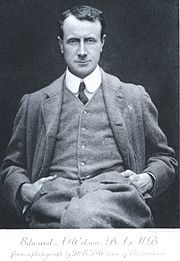
180px-Edward_A._WilsonEdward Adrian Wilson (“Uncle Bill”) (1872–1912) was an English physician, polar explorer, natural historian, painter and ornithologist. Until very recently I knew very little about Edward A. Wilson other than his name and his association with naturalism and polar exploration. I came across a book with the title The Faith of Edward Wilson, by George Seaver. The title intrigued me thus I did some digging into the story of this remarkable man who died at the young age of 39.

First, there is plenty on the Internet to introduce you to Wilson’s life and prodigious work if you care to explore further. Just use your search engine. There is even a website devoted entirely to Wilson at www.edwardawilson.com. It makes for very interesting reading if you have the time and interest. On this well-done Wilson site I encountered this biographical material about his college years at Cambridge. This genuinely drew my interest.

Despite his popularity, in many ways Wilson cut an isolated figure. Underneath the jovial veneer, he was still a sensitive and highly strung young […]

A Beautiful Testimony to Missional-Ecumenism

By |2015-01-23T16:24:00-06:00December 10th, 2013|Categories: ACT 3, Current Affairs, Evangelism, Friendship, Missional-Ecumenism, The Church, The Future|

During 2013 ACT3 conducted five area-wide Unity Factor Forums. You can learn more about these events on our site. (I hope we can do 5-6 more in 2014 so please consider inviting us to do one in your area.) The last one that we did in 2013 was in Aurora, Illinois. I asked Fr. David Engbarth, a local Catholic priest, to share something of his own journey into missional-ecumenism. He surprised me when he invited a non-Catholic friend to stand with him in order to talk about their deep and growing friendship. There is a popular saying that says “a picture is worth a thousand words.” If this is true then this video says more about what ACT3 is seeking to do than anything I can write. In the light of my post on December 2, about Pope Francis’ letter Evangelii Gaudium, this is a wonderful follow-up that reveals the human reality of love between two brothers from different ecclesial traditions. 

Philip Schaff and the Unity of Christendom – Part Two

By |2021-07-02T06:15:00-05:00December 9th, 2013|Categories: ACT 3, American Evangelicalism, Church History, Church Tradition, Creeds, Current Affairs, Missional-Ecumenism, Orthodoxy, Reformed Christianity, Roman Catholicism, The Church, The Future, Unity of the Church|

UnityIcon3Last week I wrote about the unity of the church in light of my visit to Moody Bible Institute on December 3 and the dialogue that took place between Fr. Robert Barron and me before Moody students in Chicago. I then cited the work of the famous theologian Philip Schaff. I ended my final blog of the week last Thursday by promising to reflect on Schaff’s “means” for the pursuit of visible unity.

Think of this very carefully – one hundred and twenty years ago this great Reformed theologian referred to what he called the “moral means” by which a similar affiliation and consolidation of the different churches may be hastened in the future. His points are as fresh now as when he wrote them in 1893. These are:

  1. The cultivation of an irenic and evangelical-catholic spirit in the personal intercourse with our fellow-Christians of other denominations. We should meet these other Christians “on common rather than disputed ground, and assume that they are as honest and earnest as we in the pursuit of truth.” he says we should […]

Philip Schaff and The Unity of Christendom – Part One

By |2021-07-02T06:15:00-05:00December 5th, 2013|Categories: ACT 3, American Evangelicalism, Church History, Church Tradition, Current Affairs, History, Kingdom of God, Missional Church, Missional-Ecumenism, Orthodoxy, Personal, Reformed Christianity, Roman Catholicism, The Church, The Future|

Unknown-2In the year in which he died (1893), Philip Schaff wrote what I take to be an extremely important piece on ecumenism with the title “The Reunion of Christendom.” It begins by quoting John 17:20–21 and then states the difficulty of the ecumenical problem by saying that the answer to the question the disciples asked Jesus, when they said – “Who then can be saved?” – may well be applied to the question, “How shall the many sections of the Christian world be united?” Schaff answers this query by quoting Matthew 19:25-26, “With men this is impossible, but with God all things are possible.”

Make no mistake regarding Philip Schaff’s view of the subject of Christian unity. He believed that “in a manner far better than we can devise or hope, he [God] will, by the power of his Spirit, unite all his children into one flock under one Shepherd.” Schaff said that this reunion “presupposes an original union” which was marred and obstructed.

I concur with Schaff in this belief and passion. I also agree with him that […]

The Mercersburg Movement: How Reformed Theology Helped Me Become a Missional-Ecumenist

By |2021-07-02T06:15:00-05:00December 4th, 2013|Categories: ACT 3, American Evangelicalism, Church History, History, Missional-Ecumenism, Reformed Christianity, Roman Catholicism, The Church, Theology|

Yesterday. I quoted nineteenth century theologian-historian Philip Schaff (1819–1893), a Swiss-born, German-educated Reformed Protestant minister who became a widely regarded church historian at the end of his life. Schaff spent most of his adult life living and teaching in the United States. His works are still read though his history is now dated by the simple fact that he died in 1893.

Phillip_SchaffPhilip Schaff, along with John Williamson Nevin, were the highly regarded leaders of what became known as Mercersburg Theology. This Mercersburg Movement began in the mid-nineteenth century in Mercersburg, Pennsylvania, the home of Marshall College from 1836 until its merger with Franklin College (Lancaster, PA), in 1853. It was the home for the seminary of the Reformed Church in the United States (RCUS) from 1837 until its relocation to Lancaster in 1871. This seminary was connected to what was known as the German Reformed Church, a church family that eventually merged into a union that became the Evangelical and Reformed Church. In 1957 the Evangelical and Reformed Church merged with the Congregational Christian Church, a decision […]

A Catholic-Evangelical Dialogue at Moody Bible Institute

By |2021-07-02T06:15:00-05:00December 3rd, 2013|Categories: ACT 3, Missional-Ecumenism, Patristics, Personal, Roman Catholicism, The Church, The Future, Unity of the Church|

Unknown-2Today, at 3:00 p.m. (CST), I will speak before a student-sponsored gathering at Moody Bible Institute in Chicago. I was asked, several months ago, if I could arrange an ecumenical dialogue and discussion that would feature me alongside of a prominent Catholic theologian and author. My first thought was to invite my friend, Fr. Robert Barron, to join me for this event. When he agreed to the invitation, and we found a suitable time for us both to be on campus with these students, we accepted their gracious invitation.

Unknown-3Our dialogue tomorrow will begin with a welcome by a Moody student leader which will be followed by an introduction given by our moderator, Dr. Bryan Litfin (Ph.D. in the field of ancient church history at the University of Virginia). Dr. Litfin is a professor of theology at Moody Bible Institute. Bryan is also a first-rate patristics scholar and has often encouraged Christian dialogue as a part of his teaching. He is the author of Getting to Know the Church […]